
Last Updated on April 18, 2026
Your network perimeter is gone. It left quietly, somewhere between the first mass remote-work rollout and the fourth cloud migration your company ran in three years. Is the old idea that users inside your network are safe and everyone outside is a threat? That model has been failing organisations for the better part of a decade. Zero Trust Security Architecture is what replaces it.
This guide covers how Zero Trust actually works in 2026, what the major frameworks say, how to start implementing it without breaking your existing infrastructure, and what mistakes tend to derail projects before they deliver results. No vendor pitches. Just the practical stuff security teams actually need.
What Zero Trust Security Architecture Means
Zero Trust is not a product you buy. It’s a security philosophy, and then an architecture you build from that philosophy. The core principle: never trust, always verify. Zero Trust requires strict identity verification for every user and device requesting access to resources, regardless of their location. It eliminates implicit trust by assuming all users and devices are potential threats and mandates verification at every access point through methods like least privilege access and continuous authentication.
That second part is where the real change happens. Traditional network security assumed that once you were inside the perimeter, you were trustworthy. A VPN credential was basically a skeleton key. Zero Trust throws that model out entirely.
Think of it this way: a traditional office building checks your badge at the front door, then lets you walk anywhere. A Zero Trust building checks your badge at every room, every floor, every time. That sounds annoying until you realise how many people sneak in through fire exits.
The Three Core Principles You Need to Know
Always Verify. No user, device, or application is trusted by default, even if they are already inside the network perimeter. Every session and every request needs to be verified before access is granted.
Least Privilege Access. Users get the minimum permissions they actually need to do their job. Not a department-wide rights package. Not “admin access because it’s easier to manage.” Just what’s necessary, when it’s necessary.
Assume Breach. This principle demands strategies and controls that identify, contain, and mitigate threats once the perimeter is breached. Continuous monitoring, rapid response mechanisms, and constant validation of identities and behaviours are key elements. You design your security as if attackers are already inside, because statistically, they often are.
Why 2026 Is the Year Most Organisations Simply Can’t Wait
Zero Trust has been discussed as “the future of security” for fifteen years. At some point, the future arrives. In 2026, it has.
Overall, 65% of organisations plan to replace VPN services within the year, a 23% jump from last year’s findings. Meanwhile, 96% of organisations favour a Zero Trust approach, and 81% plan to implement Zero Trust strategies within the next 12 months.
Why the sudden urgency? A few things converged.
Remote and hybrid work is now permanent for most organisations. With 58% of employees working in hybrid or fully remote environments, organisations must secure access from any location while maintaining productivity and user experience. At the same time, insider threats, whether malicious or negligent, account for 34% of security incidents, costing organisations an average of $16.2 million per incident.
VPNs, long the default fix for remote access, are now actively dangerous. 56% of organisations reported VPN-exploited breaches last year, a notable rise from the year prior. Because VPNs are internet-connected devices, threat actors can easily probe for impacted VPN infrastructure and exploit it before any patch is released or has been applied. If your organisation still relies on traditional VPNs as the primary remote access layer, our guide on the best free OpenVPN alternatives is a useful starting point for understanding what a modern alternative looks like.
Ransomware attacks increased 156% since 2023, and the average breach cost now sits at $4.8 million, according to the FBI IC3 Report for Q4 2025. These aren’t abstract statistics. They represent real organisations that probably thought their existing defences were adequate.
The Seven Pillars of Zero Trust Architecture
The US Department of Defense, working with the NSA and DISA, built its Zero Trust reference architecture around seven pillars. These are:
- User: (continuous authentication, assessment, and monitoring of user activity)
- Device: (evaluating the health and trustworthiness of devices)
- Applications and Workloads: (securing applications, containers, and VMs)
- Data: (tagging, securing, encrypting, and governing access to sensitive data)
- Network and Environment: (segmenting and isolating environments to restrict lateral movement)
- Automation and Orchestration: (enabling adaptive, automated security responses)
- Visibility and Analytics : (monitoring behaviours and analysing telemetry to improve detection and response)
Most organisations can’t tackle all seven at once. Here’s what each pillar actually demands on the ground.
Identity and Device Trust Come First
Identity is the new perimeter. Before worrying about network segmentation, sort your Identity and Access Management (IAM). Multi-factor authentication (MFA), single sign-on (SSO), and role-based access controls are the foundation. If credentials are compromised, MFA is often what stops a breach from becoming catastrophic.
Device trust runs alongside identity. A valid username from an unpatched, unmanaged laptop is still a security risk. Zero Trust requires that the device accessing your systems is healthy, known, and authorised, not just that the user’s password looks right. Good credential management matters too. Our roundup of the best password managers for Android covers tools useful for individual and small-team contexts.
Network Segmentation Stops Lateral Movement
This is where most organisations currently fall short. Over 90% of organisations are currently using or planning to use network segmentation as part of their Zero Trust strategy. Still, of that group, nearly three-quarters rely on firewalls and VLANs. Just 5% leverage microsegmentation.
The problem with VLANs and traditional firewalls is that they’re coarse. Once an attacker gets past them, they can move relatively freely across your environment. Microsegmentation creates boundaries around individual workloads, so a compromised server in one segment can’t automatically reach databases or systems in another. It’s the difference between a fire spreading through one room versus an entire building.
Data Protection and Visibility
Zero Trust treats data as the thing that actually needs protecting, not the network wrapped around it. That means classifying data by sensitivity, encrypting it at rest and in transit, and keeping detailed logs of who accessed what and when. Those logs aren’t just for compliance audits. They’re how you detect anomalies before a small incident becomes a serious breach.
For teams managing sensitive data across cloud and on-premises environments, understanding what a digital certificate is and how it works matters. Certificates authenticate identities in ways that passwords alone cannot.
The NIST and CISA Frameworks Worth Following
Two frameworks dominate Zero Trust guidance in 2026: NIST SP 800-207 and CISA’s Zero Trust Maturity Model.
According to NIST SP 800-207, Zero Trust architecture is “an enterprise’s cybersecurity plan that utilises zero trust concepts and encompasses component relationships, workflow planning, and access policies.”
The NIST framework identifies three core logical components: the Policy Engine (which uses a trust algorithm to grant, deny, or revoke access), the Policy Administrator (which establishes or shuts down communication based on Policy Engine decisions), and the Policy Enforcement Point (which enables, monitors, and terminates connections).
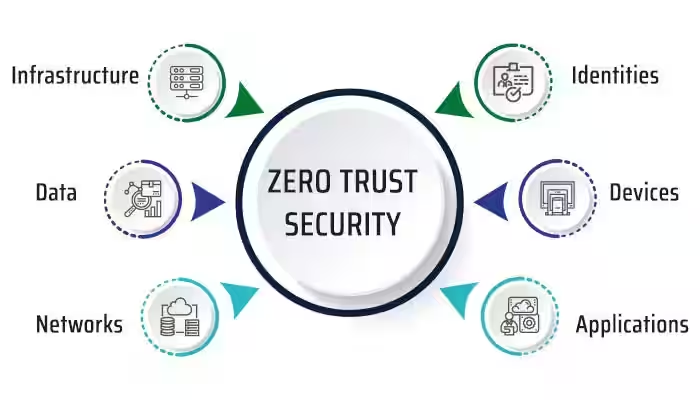
CISA’s maturity model takes a more step-by-step view. It covers five pillars: Identity, Devices, Networks, Applications, Workloads, and Data. Three cross-cutting capabilities sit across all of them: Visibility and Analytics, Automation and Orchestration, and Governance. Understanding where your organisation sits on this maturity scale before starting implementation is one of the most useful things you can do. Our post on what NIST CSF is and the complete guide to CSF 2.0 is worth reading alongside this framework.
By enforcing policies like least privilege and continuous validation, Zero Trust supports compliance with standards like GDPR, HIPAA, and NIST. If your organisation is already navigating compliance requirements, Zero Trust and compliance don’t compete. They overlap significantly, which makes the investment easier to justify to non-technical stakeholders.
How to Implement Zero Trust: A Phased Approach
Here’s what most vendor guides won’t tell you: a full Zero Trust implementation typically takes 12 to 24 months at enterprise scale. Trying to do everything at once creates chaos and stakeholder exhaustion. The practical approach is phased, and it starts smaller than most people expect.
Phase 1: Map What You Actually Have
You can’t protect what you can’t see. Start with a thorough audit of your current infrastructure: users, devices, applications, data flows, and access permissions. This phase often surfaces uncomfortable surprises, such as legacy systems with overly permissive access rules, dormant accounts with admin rights, and data stored in places nobody officially documented.
This is also the moment to identify your highest-risk users and most critical assets. A developer with admin access to your production database is a very different risk profile from a marketing analyst with read-only access to campaign data.
Phase 2: Start with Identity, Then Expand
Identity delivers the highest return on investment in the early stages. Deploy MFA broadly. Establish privileged access management (PAM) for your most sensitive accounts. Implement single sign-on so access is centralised and auditable.
Once identity controls are solid, move to device trust. Deploy endpoint detection and response (EDR) tools that feed device health data into your access decisions. Our guide on the best EDR tools for small businesses helps smaller teams start here without enterprise-scale budgets.
Phase 3: Network and Application Access Controls
Replace broad VPN access with Zero Trust Network Access (ZTNA). Rather than granting network-level access, ZTNA connects users directly to specific applications based on verified identity and device health. Enterprises that have transitioned to Zero Trust from VPN found improved security and compliance as the primary advantage, with 76% citing that benefit.
Start microsegmentation with your most sensitive environments. Production databases, financial systems, and customer data stores are the obvious starting points. The goal isn’t to segment everything immediately. It’s to stop attackers from moving sideways freely if they get a foothold somewhere.
For teams running hybrid infrastructure, the intersection of edge computing and cloud computing adds another layer of complexity that Zero Trust policies need to cover consistently, whether the resource sits in a data centre, a public cloud, or at the network edge. Our post on the best cloud storage solutions for businesses also covers how access policies map to different cloud environments.
Phase 4: Continuous Monitoring and Automated Response
Zero Trust isn’t a state you reach. It’s an ongoing operational practice. Ongoing validation ensures your Zero Trust strategy keeps pace with reality, not just frameworks. Bringing it all together requires identifying exposure and eliminating implicit trust, then continuously validating that controls are working as intended.
Automate wherever you can. Manual security reviews don’t scale, and attackers don’t wait for quarterly audits. Security orchestration tools, anomaly detection, and automated response playbooks help your team respond faster than any human-only process allows. Our guide on how to defend against AI-powered cyberattacks covers the threat landscape and response strategies in practical detail.
Common Mistakes That Derail Zero Trust Projects
A few patterns keep appearing in organisations that struggle with Zero Trust adoption. Worth knowing before you start.
Treating it as a technology purchase. Zero Trust is an architectural approach. Buying a single product and calling it done doesn’t work. Architecture first, then tools.
Trying to do everything at once. Deploying identity, device trust, microsegmentation, data protection, and analytics simultaneously burns out teams and creates fragmented implementations that don’t reduce risk as intended. Phase it deliberately.
Neglecting the user experience. Strict access controls that frustrate users push them toward workarounds. A developer who can’t access what they need will find another way, often a less secure one. Good Zero Trust design accounts for this.
Skipping the visibility piece. Without visibility into how your controls are configured and where gaps exist, you can’t enforce Zero Trust effectively. Logging, monitoring, and analytics aren’t optional extras. They’re what make the rest of the architecture function properly.
Forgetting third-party access. Modern business operations rely on extensive partner ecosystems, requiring granular access controls and continuous monitoring of third-party connections. Contractors, vendors, and partners with access to your systems are part of your risk surface. They need to be in scope.
The complete cybersecurity toolkit for SMBs is a useful companion resource if your team is building broader security capabilities alongside Zero Trust. And if you want to keep tabs on how to detect early signs of compromise, our guide on how to tell if your email has been hacked covers practical indicators that most organisations miss.
Zero Trust and the AI Threat Landscape in 2026
One thing that genuinely changes the calculation in 2026 is the role of AI on both sides of the security equation. Attackers use AI to automate and scale attacks. Identity becomes the primary security control layer. Attackers are also probing VPN vulnerabilities faster than patches can be released, using automated tooling that didn’t exist three years ago.
On the defence side, AI helps Zero Trust architectures adapt in real time. Machine learning models can detect unusual access patterns that no human analyst would catch manually, such as a service account accessing data at 3am that it has never touched before, or a user authenticating from two countries within 30 minutes.
In 2026, organisations implementing Zero Trust AI Security reported 76% fewer successful breaches and reduced incident response times from days to minutes. That’s not just a headline number. It reflects what happens when automated detection and Zero Trust access controls work together instead of operating in separate silos.
A Zero Trust implementation without strong analytics and AI-assisted detection is significantly less effective than one that includes them. The visibility and analytics pillar isn’t decorative. It’s what makes the rest of the architecture respond to real threats rather than theoretical ones. For a deeper look at how AI is reshaping defence strategies, our post on the best AI tools for tech professionals covers tooling worth evaluating.
Conclusion
Zero Trust Security Architecture is not the future of cybersecurity. It is the current standard. The organisations still operating on implicit perimeter trust in 2026 are using an architecture that attackers understand well, have practised exploiting, and have largely mapped out. The good news is that you don’t need to implement everything at once. Start with identity. Layer in device trust. Segment your most sensitive environments. Build visibility into everything you do. Each step reduces real risk and makes the next phase easier to justify and execute.
10 Frequently Asked Questions About Zero Trust Security Architecture
Zero Trust means no user, device, or system is automatically trusted, even inside your network. Every access request is verified each time based on identity, device health, and context before access is granted.
Zero Trust scales to any organisation size. Smaller businesses can begin with MFA and identity controls, then expand gradually. Many cloud-based tools make entry-level Zero Trust accessible without requiring enterprise budgets or specialist teams.
Full enterprise-scale implementation typically takes 12 to 24 months. Most organisations run a 3 to 6 month identity-focused pilot first to prove value, then expand to networks, applications, and data protection in subsequent phases.
VPNs grant broad network access once credentials are verified. Zero Trust grants access only to specific applications or resources based on continuous verification of identity, device health, and behavioural context each time access is requested.
The two most widely followed are NIST SP 800-207 and CISA’s Zero Trust Maturity Model. The US Department of Defense also publishes a seven-pillar reference architecture that many enterprise security teams use as a practical blueprint.
Microsegmentation divides your network into small, isolated zones around individual workloads or systems. It stops attackers from moving freely across your infrastructure, even after breaching one area. Currently, only 5% of organisations use it fully.

- OpenAI Discovers Self-Replicating Prompt Injection - September 27, 2026
- AI Safety Monitors Are Being Tested: What AISI Found - September 25, 2026
- Top 10 Influencer Marketing Agencies in Delhi - September 24, 2026