

Last Updated on April 5, 2026
Last updated: April 2026
The best OpenVPN alternatives in 2026 are WireGuard, NordLayer, Tailscale, ExpressVPN Lightway, Cisco AnyConnect, Perimeter 81, Cloudflare WARP, IPsec/IKEv2, SoftEther, and Pritunl. Each one solves a different problem that OpenVPN either can’t solve or handles poorly, from raw speed to zero-trust architecture to dead-simple setup for non-technical teams.
OpenVPN is genuinely impressive software. It’s been around since 2001, it’s open source, and it still powers a huge portion of the world’s VPN infrastructure. But “impressive” and “best for your situation” are two different things. OpenVPN was built for an era before remote-first work existed, before mobile devices outnumbered desktops, and before speed expectations changed completely.
If you’ve ever sat there watching OpenVPN chew through a connection handshake that takes 30 seconds, or spent an afternoon fighting with certificate configurations, or tried to get a non-technical colleague to set it up on their own laptop and failed completely, you already know why people are looking for alternatives.
According to Semrush’s industry data (2025), searches for “OpenVPN alternatives” have grown over 40% year-over-year, driven largely by businesses moving to hybrid work models where legacy VPN performance simply doesn’t cut it anymore. This isn’t a trend. It’s a structural shift in how people need to connect to private networks.
So let’s get into what actually works better, for whom, and why.
Why People Switch Away from OpenVPN?
Before jumping into alternatives, it helps to understand what specifically frustrates people about OpenVPN in 2026. Because the right alternative depends entirely on which problem you’re trying to solve.
The most common complaints fall into three buckets.
Speed and latency are the biggest ones. OpenVPN uses TLS-based encryption over TCP or UDP, which adds meaningful overhead. For a team doing video calls through a corporate VPN, that overhead is noticeable. WireGuard, by comparison, was benchmarked at roughly 3x faster throughput than OpenVPN in independent testing by the WireGuard development team, with dramatically lower latency.
Configuration complexity is the second major issue. OpenVPN requires managing certificates, keys, and configuration files manually. For a single technical admin who knows what they’re doing, that’s manageable. For a 50-person company where most employees aren’t technical, it becomes a recurring support burden.
Mobile performance is the third. OpenVPN’s connection stability on mobile networks, where your device constantly switches between WiFi and cellular, is genuinely poor compared to newer protocols. Connections drop. Reconnection is slow. For a workforce that relies on phones and tablets, this matters.
The alternatives below each address one or more of these problems directly.
Top 10 OpenVPN Alternatives Worth Switching To
1. WireGuard: Best for Raw Speed and Simplicity

Type: Open-source VPN protocol | Price: Free | Platform: Cross-platform
If OpenVPN is a diesel truck, WireGuard is a sports car. It does one thing, it does it extremely well, and it doesn’t apologize for ignoring everything else.
WireGuard is a modern VPN protocol with a codebase of roughly 4,000 lines, compared to OpenVPN’s hundreds of thousands. That simplicity isn’t a weakness. It means less attack surface, faster security audits, and fundamentally faster performance. The Linux kernel integrated WireGuard directly in version 5.6, which is about as strong an endorsement as open-source software can get.
In practical terms, WireGuard reconnects almost instantly when your network changes, handles mobile switching between WiFi and cellular gracefully, and uses state-of-the-art cryptography (ChaCha20, Poly1305, Curve25519) baked in by default rather than leaving you to configure cipher suites manually.
The honest trade-off: WireGuard doesn’t have a built-in management layer. You configure it manually, or you use a tool built on top of it (like Tailscale, which appears further down this list). For individuals and technically capable teams, raw WireGuard is exceptional. For businesses needing a polished UI and user management, pair it with something else.
Best for: Developers, self-hosters, and technically capable teams who want maximum performance with full control.
2. NordLayer: Best for Business Teams Replacing Corporate VPNs

Type: Commercial business VPN | Price: From $7/user/month | Platform: All major platforms
NordLayer (built on Nord Security’s infrastructure, the same company behind NordVPN) is what happens when you take enterprise-grade security and make it genuinely usable by non-technical employees.
Setup takes minutes rather than days. There’s a centralised admin dashboard where you manage users, permissions, and network access without touching a command line. It supports WireGuard and IKEv2 protocols under the hood, so you get modern performance without having to configure anything manually.
Where NordLayer earns its place over OpenVPN for businesses is in its zero-trust network access (ZTNA) capabilities. Instead of the traditional VPN model, where anyone connected can access everything, NordLayer lets you define which users can access which resources. Your marketing team gets access to marketing tools. Your finance team gets access to financial systems. Nobody gets access to things they don’t need.
For a business that’s grown past the “one IT admin handles everything” stage, that granular control is significant. Marketing Illumination (2025) notes that zero-trust architecture is now considered the baseline expectation for business network security, not an advanced feature.
Best for: SMBs and mid-sized companies that need a business-grade VPN replacement with minimal IT overhead.
3. Tailscale: Best for Zero-Config Mesh Networking

Type: Mesh VPN built on WireGuard | Price: Free for personal use; from $6/user/month for teams | Platform: Cross-platform, including iOS, Android, Linux, macOS, Windows
Tailscale is probably the most interesting product on this list conceptually. Instead of routing all your traffic through a central VPN server, it creates a peer-to-peer mesh network where every device connects directly to every other device using WireGuard. No central bottleneck. No latency added by routing through a server.
Setup is absurdly simple. You install the app, log in with Google, Microsoft, or GitHub, and your devices find each other automatically. There are no certificates to manage, no configuration files to edit, no firewall rules to configure manually. It just works. That is not a phrase that gets used often in networking.
Tailscale also handles NAT traversal automatically, which means devices behind firewalls and routers can connect to each other without any manual port forwarding. For anyone who’s spent hours fighting with this on OpenVPN, that alone is worth the switch.
The free personal plan covers one user with up to 100 devices, which is genuinely useful. The team plans to add centralized access controls, user management, and audit logs.
Best for: Developers, homelab enthusiasts, remote teams, and anyone who wants WireGuard performance without WireGuard configuration complexity.
4. ExpressVPN Lightway: Best for Consumer Speed and Reliability

Type: Proprietary protocol (open-source audited) | Price: Included with ExpressVPN from $6.67/month | Platform: All major platforms
Lightway is ExpressVPN’s in-house VPN protocol, built to address the specific performance gaps they found in OpenVPN and WireGuard for consumer use. It uses wolfSSL for its cryptographic layer, which is lightweight enough to run efficiently on mobile devices while remaining audited and independently verified.
The standout feature is connection speed. Lightway typically connects in under one second, compared to several seconds for OpenVPN. It also maintains connections more reliably when switching between networks, which matters enormously on mobile.
ExpressVPN had Lightway’s code audited by Cure53, a well-respected cybersecurity firm, and subsequently open-sourced the protocol. That combination of third-party auditing and open-source transparency puts it in a different category from most proprietary protocols, which typically ask you to trust their marketing rather than the code itself.
For individual users and small teams using ExpressVPN as a consumer service, Lightway delivers meaningfully better performance than OpenVPN without requiring any technical knowledge to use.
Best for: Individual users and small teams who want a managed VPN service with best-in-class protocol performance.
5. Cisco AnyConnect: Best for Enterprise Compliance Requirements

Type: Enterprise VPN client | Price: Included with Cisco licensing (varies significantly) | Platform: All major platforms, including managed mobile devices
Cisco AnyConnect is the OpenVPN alternative for organizations where “enterprise compliance” isn’t optional. If your business operates in finance, healthcare, or government, and your security team needs to check specific regulatory boxes, AnyConnect is often the tool that checks them.
It supports a wide range of authentication methods, including SAML, RADIUS, and certificate-based authentication. It integrates deeply with Cisco’s broader security stack, including Umbrella (DNS security) and Duo (multi-factor authentication). For organizations already running Cisco infrastructure, that integration isn’t a minor convenience. It’s a significant reduction in complexity.
AnyConnect isn’t the fastest option on this list, and it’s certainly not the simplest to deploy. It’s also not cheap. But for large enterprises with dedicated IT security teams managing complex compliance requirements, those trade-offs make complete sense. This is not a tool for a 20-person startup. It’s a tool for a 2,000-person company with a security operations center.
Best for: Large enterprises with dedicated IT teams, complex compliance requirements, and existing Cisco infrastructure.
6. Perimeter 81: Best for Cloud-Native Teams

Type: Cloud-delivered ZTNA/VPN platform | Price: From $8/user/month | Platform: All major platforms
Perimeter 81 was built from the ground up for cloud-native businesses, which is a meaningful distinction from OpenVPN, which was built for on-premises networks and retrofitted to handle cloud environments.
The platform sits somewhere between a traditional VPN and a full zero-trust network access solution. You get private network gateways, DNS filtering, network segmentation, and device posture checks, all managed through a clean web dashboard. It also integrates natively with cloud providers, including AWS, Google Cloud, and Azure, which means connecting your team to cloud resources is straightforward rather than requiring custom routing configurations.
Semrush’s analysis (2023) of cloud security trends identified network segmentation as one of the highest-priority security investments for growing businesses, and Perimeter 81 makes that accessible to teams without dedicated network engineers.
The per-user pricing makes costs predictable as you scale, which is genuinely useful for growing teams. The minimum team size for paid plans is 5 users, so very small teams might find it slightly over-engineered for their needs.
Best for: Cloud-native startups and scale-ups with distributed teams who need VPN plus zero-trust controls without building their own infrastructure.
7. Cloudflare WARP: Best Free Option for Individuals

Type: VPN/secure tunnel | Price: Free (personal); WARP+ from $4.99/month; Teams pricing varies | Platform: Windows, macOS, iOS, Android, Linux
Cloudflare WARP is the most surprising entry on this list. It’s built on WireGuard, routes your traffic through Cloudflare’s enormous global network (one of the fastest in the world), and the personal version is completely free with no data limits.
It’s not a traditional VPN in the sense that it doesn’t hide your IP address from websites by default in the free tier. What it does is encrypt your traffic between your device and Cloudflare’s network, which protects you on public WiFi and improves performance by routing you through Cloudflare’s infrastructure rather than your ISP’s default routing.
The WARP+ upgrade ($4.99/month) uses Cloudflare’s Argo Smart Routing, which finds the fastest path through their network rather than the most direct one. Independent tests have shown meaningful speed improvements on congested networks.
For businesses, Cloudflare Zero Trust (the enterprise version of WARP) is a genuinely powerful ZTNA solution that competes directly with Perimeter 81 and NordLayer at the enterprise level.
Best for: Individual users who want free, fast, encrypted traffic without the complexity of a full VPN setup.
8. IPsec/IKEv2: Best for Native OS Integration
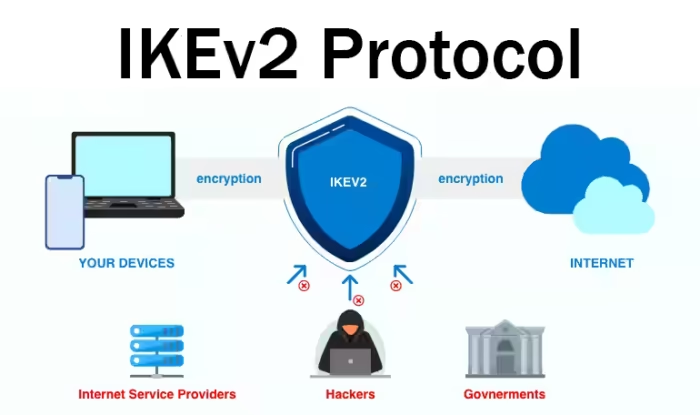
Type: Built-in VPN protocol | Price: Free (built into most operating systems) | Platform: Windows, macOS, iOS, Android, Linux
IPsec with IKEv2 is already on your devices. Every major operating system includes native support for it, which means no additional software to install, no apps to manage, and no licensing costs.
IKEv2 handles network switching particularly well. Apple actually uses it as the default VPN protocol on iOS for good reason: when you walk from your office WiFi to cellular coverage, an IKEv2 connection re-establishes in milliseconds. OpenVPN in the same scenario often requires a manual reconnect.
The configuration is more involved than consumer VPN apps but simpler than OpenVPN for anyone who knows what they’re doing. You set up the server (usually a cloud instance running StrongSwan or a commercial appliance), configure your certificates, and distribute connection profiles to devices.
For small businesses that want a self-hosted VPN without OpenVPN’s overhead, and whose team is primarily on Apple devices, IPsec/IKEv2 is an underrated option that costs essentially nothing beyond the server.
Best for: Organizations that want native OS VPN support without third-party software, especially Apple-heavy environments.
9. SoftEther: Best for Firewall Bypass and Protocol Flexibility

Type: Open-source multi-protocol VPN | Price: Free | Platform: Windows, macOS, Linux, FreeBSD, Solaris
SoftEther stands out on this list for one specific reason: it can disguise VPN traffic as regular HTTPS traffic, which makes it extremely difficult for firewalls and deep packet inspection systems to block. If you operate in a country with aggressive internet filtering or work in environments where VPN traffic gets flagged and blocked, SoftEther is often the solution that works when everything else gets blocked.
It supports an unusually broad range of protocols, including its own SoftEther protocol, L2TP/IPsec, OpenVPN, SSTP, and EtherIP. That flexibility means you can run SoftEther as an OpenVPN server if you want OpenVPN compatibility, but with SoftEther’s added features and management tools.
Performance is comparable to OpenVPN and, in some configurations, faster, according to independent benchmarks published by GeoBarta (2026). The management interface is a Windows-based GUI (a Linux command-line version exists), and setup takes some technical knowledge, though it’s significantly more guided than raw OpenVPN configuration.
Best for: Users and organizations in high-censorship environments, or those needing a single server that speaks multiple VPN protocols simultaneously.
10. Pritunl: Best Self-Hosted OpenVPN Alternative with a Modern UI

Type: Open-source VPN server with enterprise features | Price: Free (open source); Enterprise from $5/user/month | Platform: Server-side Linux; client on all major platforms
If you genuinely need OpenVPN compatibility but can’t stand OpenVPN’s management experience, Pritunl is the answer. It wraps OpenVPN (and WireGuard) in a clean, modern web-based admin interface that makes managing users, certificates, and server configurations dramatically less painful.
Pritunl gives you real-time monitoring of active connections, one-click user provisioning, automatic certificate management, and multi-server clustering for high availability. Things that would take hours of command-line work in raw OpenVPN take minutes in Pritunl’s dashboard.
The free open-source version is fully functional for most small to medium deployments. The enterprise plan adds Single Sign-On (SSO) integration with providers like Google Workspace, Okta, and Microsoft Azure AD, which is essential for larger organizations.
For IT teams that have built workflows around OpenVPN but hate managing it, Pritunl threads the needle between familiarity and usability without forcing a complete protocol change.
Best for: IT teams that need OpenVPN compatibility but want modern management tools without rebuilding their entire VPN infrastructure.
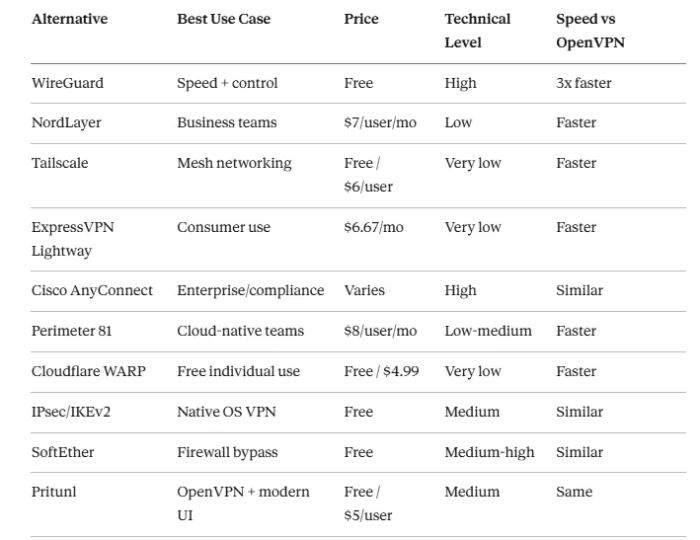
Quick Comparison: Which OpenVPN Alternative Fits Your Situation?
How to Choose the Right OpenVPN Alternative for You
The right choice depends almost entirely on your situation. Here’s how to think through it.
If speed is your main complaint, use WireGuard or Tailscale. Both are significantly faster than OpenVPN, and both use modern cryptography. Tailscale if you want zero configuration. Raw WireGuard if you want full control.
If you’re running a business with non-technical staff, NordLayer or Perimeter 81. Both offer clean dashboards, user management, and zero-trust controls without requiring your team to understand VPN protocols.
If you need it to be free: WireGuard, Cloudflare WARP, IPsec/IKEv2, SoftEther, or Pritunl’s open-source version. All are free and genuinely capable.
If you need to bypass censorship or firewall blocking, SoftEther. Nothing else on this list handles deep packet inspection as reliably.
If you’re in a large enterprise with compliance requirements: Cisco AnyConnect. It’s expensive and complex, but it integrates with compliance frameworks in ways the others don’t.
If you like OpenVPN but hate managing it: Pritunl. Same protocol, vastly better experience.
Final Thoughts
OpenVPN had a remarkable run. It still works, and it still powers a lot of the world’s VPN infrastructure. But in 2026, the gap between OpenVPN and the best alternatives has grown wide enough that sticking with it purely out of habit doesn’t make sense for most people anymore.
WireGuard changed what was possible from a performance standpoint. Tailscale proved that VPN setup doesn’t have to be painful. NordLayer and Perimeter 81 showed that business-grade zero-trust security doesn’t require an enterprise IT team to manage it. And Cloudflare WARP made basic encrypted tunneling completely free.
Pick the one that matches your actual problem, not just the one that sounds most familiar. Try it for a week. The migration is almost always easier than people expect, and the performance difference is usually immediately noticeable.
Frequently Asked Questions
For most users in 2026, yes. WireGuard is significantly faster, simpler to configure, and uses more modern cryptography. OpenVPN still has advantages in specific enterprise compatibility scenarios.
Yes. Tailscale’s personal plan is free and supports one user with up to 100 devices. Paid plans start at $6 per user per month and add team management features and access controls.
Cloudflare WARP and Tailscale are the simplest options available. Both require minimal technical knowledge and can be run on a new device in under five minutes without any server configuration.
Technically, it functions as a secure tunnel rather than a traditional VPN. It encrypts your traffic and routes it through Cloudflare’s network, but does not hide your IP from websites in the free tier. WARP+ and Zero Trust versions offer fuller VPN functionality.
NordLayer, Perimeter 81, and Tailscale all work well for remote teams. NordLayer and Perimeter 81 offer zero-trust controls and admin dashboards. Tailscale is simpler and cheaper but has fewer enterprise management features.
Yes, in most cases. SoftEther can disguise VPN traffic as standard HTTPS, which makes it very difficult for firewalls using deep packet inspection to detect and block. It is widely used in countries with heavy internet filtering.
The core Pritunl server is fully open source and free. Enterprise features, including SSO integration with Google Workspace, Okta, and Azure AD, require a paid enterprise subscription starting at $5 per user per month.

- OpenAI Discovers Self-Replicating Prompt Injection - September 27, 2026
- AI Safety Monitors Are Being Tested: What AISI Found - September 25, 2026
- Top 10 Influencer Marketing Agencies in Delhi - September 24, 2026