
A sensor on a factory floor detects unusual vibration in a machine. Left unchecked, that vibration becomes a breakdown. A breakdown on this particular line costs the company $50,000 per hour in lost production.
The sensor sends data to a cloud server 800 kilometers away. The server processes it and sends back an alert. The round trip takes 340 milliseconds. In those 340 milliseconds, the machine has already crossed the threshold into damage territory.
Now run the same scenario with edge computing. The sensor sends data to a local edge server sitting ten meters away on the factory floor. Processing happens in under 5 milliseconds. The alert fires before the threshold is crossed. The machine stops. The $50,000 loss does not happen.
That one scenario explains why the edge computing vs cloud computing conversation matters for real businesses in 2026. It is not a technical debate. It is a practical decision about where your data gets processed and how fast that needs to happen.
Core Difference Between Edge and Cloud Computing?
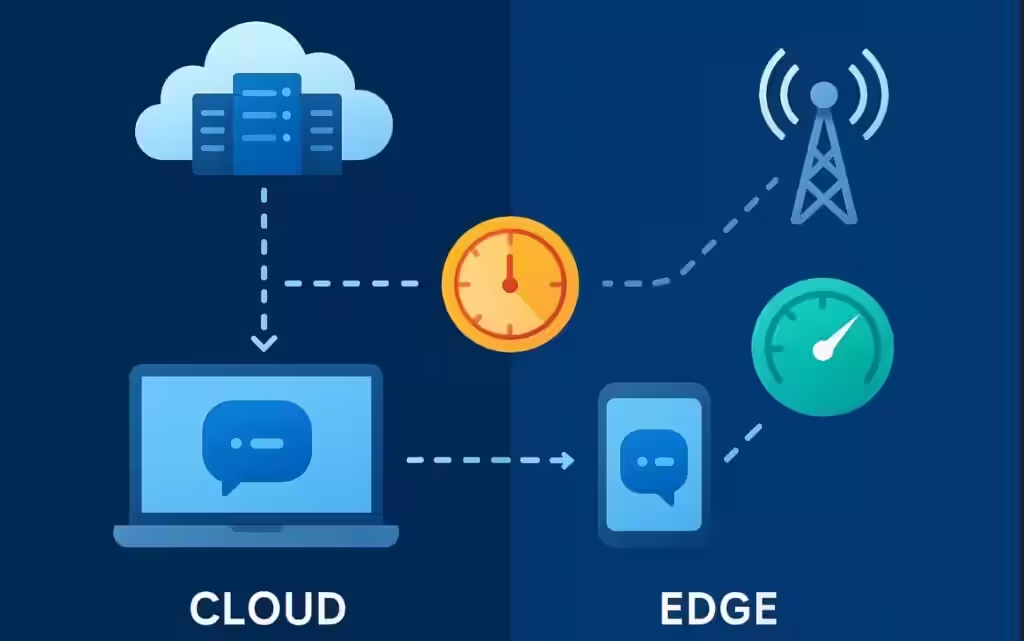
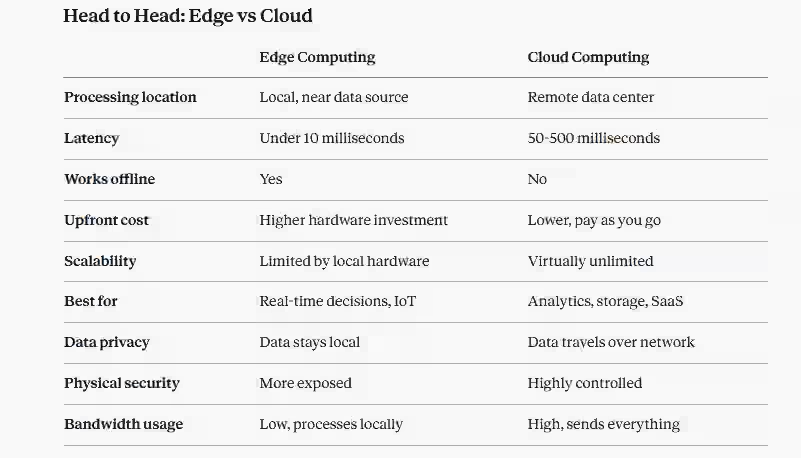
Cloud computing processes your data in remote data centers run by providers like AWS, Microsoft Azure, and Google Cloud. Your device sends data out, it travels to a server potentially hundreds of kilometers away, gets processed, and the result comes back. Edge computing eliminates that round trip by processing data locally, on a nearby device, gateway, or server right where the data is generated.
One sends data away to be processed. The other processes it right where it is created. Everything else follows from that single difference.
How Cloud Computing Works and Where It Wins?
Cloud computing built the modern internet. Netflix, Spotify, Gmail, Slack, every major software product you use daily runs on cloud infrastructure. The model is simple: instead of buying and maintaining your own servers, you rent computing power from a provider and pay only for what you use.
AWS, Microsoft Azure, and Google Cloud, between them, handle the majority of global enterprise computing. Google Cloud was recognized by Forrester as a leader in AI infrastructure in 2025. The scale these providers operate at is genuinely difficult to comprehend. AWS alone runs more servers than most countries have computers.
What Cloud Does Best?
Cloud computing is unbeatable for tasks that require massive scale, global accessibility, or serious computing power that no single organization could justify buying outright.
Training an AI model requires thousands of GPUs running simultaneously for days or weeks. No startup can afford that hardware. On the cloud, it costs a few thousand dollars and takes hours. That is the core value proposition of cloud computing, and it has not changed.
Other tasks where cloud is the clear winner:
- Big data analytics: Processing terabytes of historical data to find patterns and insights
- Global collaboration: Teams across continents accessing the same files and applications in real time
- SaaS applications: Software that needs to serve millions of users simultaneously from anywhere
- Long-term storage: Archiving data cheaply and retrieving it when needed
- Disaster recovery: Backing up critical systems in geographically separate locations
Where Cloud Falls Short?
The weakness of cloud computing is physics. Data cannot travel faster than the speed of light, and network infrastructure adds its own delays. The round trip from a device to a cloud server and back takes anywhere from 50 to 500 milliseconds, depending on distance and network conditions.
For most applications, latency is invisible. A 200 millisecond delay in loading a webpage is imperceptible. But for systems that need to react in real time, that delay is a fundamental problem that no amount of faster internet can fully solve.
Bandwidth is the second limitation. A modern smart factory can generate terabytes of sensor data every day. Sending all of that raw data to the cloud is expensive and slow. Most of it is noise that never needs to leave the building.
How Edge Computing Works and Where It Wins
Edge computing moves the processing closer to where data is generated. Instead of sending everything to a distant data center, an edge device, which could be a local server, a gateway, a router with processing capability, or even the end device itself, handles the analysis locally.
The result is response times measured in single-digit milliseconds rather than hundreds. It also works without a reliable internet connection, which matters enormously in environments like oil rigs, remote manufacturing facilities, and underground infrastructure.
What Edge Does Best?
Edge computing is the right choice whenever speed, reliability, or data sovereignty are non-negotiable.
Autonomous vehicles process sensor data from cameras, lidar, and radar locally in under 10 milliseconds. Sending that data to a cloud server and waiting for a response before breaking is not a design choice anyone can make. Tesla, Waymo, and every other autonomous vehicle manufacturer builds powerful onboard processors directly into their vehicles for exactly this reason.
Healthcare monitoring in intensive care units uses edge devices to process patient vitals continuously and trigger alerts in real time. A cloud-dependent system introducing even 200 milliseconds of latency into a cardiac arrest alert is not acceptable in a clinical environment.
Retail and smart stores use edge processing for inventory tracking, theft detection, and cashier-free checkout. Amazon Go stores process camera and sensor data locally on edge servers inside each store. Sending that volume of real-time tracking data to a remote cloud server and waiting for responses would make the experience too slow to be practical.
Industrial IoT is currently the largest single application of edge computing, representing roughly 33% of the global edge market. Thousands of sensors monitoring temperature, pressure, vibration, and output quality need local processing to be useful in real time.
Where Edge Falls Short?
Edge devices are less powerful than cloud servers. Complex AI model training, large-scale data analytics, and tasks requiring access to global datasets all belong in the cloud. Edge is purpose-built for fast local decisions, not heavy computation.
The upfront cost is also higher. Installing edge servers on-site requires hardware investment compared to the cloud’s pay-as-you-go model. Managing thousands of distributed edge devices across multiple locations is significantly more complex than managing a centralized cloud setup.
Physical security is a genuine concern, too. A cloud server sits in a locked, monitored data center with enterprise-grade physical security. An edge device sits on a factory floor, in a retail store, or inside a vehicle, where physical access is harder to control.
The Hybrid Approach (Cloud Computing + Edge Computing)
Here is the part most comparisons miss. Edge computing and cloud computing are not competing technologies. They are complementary layers of the same architecture.
The most effective deployments in 2026 use edge for immediate local decisions and cloud for everything that benefits from scale, long-term storage, and heavy analytics. Data flows between the two layers continuously, with each handling the tasks it is genuinely better at.
A smart city traffic management system is a clean example. Edge servers at each intersection process camera feeds locally, adjust signal timing in real time based on traffic density, and respond to emergency vehicles instantly without waiting for any cloud response. All of that local data gets sent to a cloud platform where city planners analyze traffic patterns across the entire network, identify problem intersections, and plan infrastructure improvements. Edge handles the millisecond decisions. Cloud handles the strategic analysis.
AI development follows the same pattern. Models are trained in the cloud, where massive computing resources are available and cost-effective. Once trained, those models are deployed to edge devices where they run locally without cloud dependency. Your phone’s face recognition, voice assistant, and camera scene detection all use AI models that were trained in the cloud and now run entirely on the device.
This trained-in-cloud, deployed-at-edge pattern is becoming the dominant architecture for AI applications in 2026. 5G is accelerating the shift by making edge devices faster and more reliably connected to cloud infrastructure when they need it.
Which One Does Your Business Actually Need?
The decision is simpler than most technical comparisons make it sound.
Choose edge computing when
- Your application needs to respond in under 50 milliseconds
- You operate in environments with unreliable or no internet connectivity
- Regulations require sensitive data to stay on-site and never leave your facility
- You generate enormous volumes of data that would be expensive to send to the cloud continuously
- Physical safety depends on instant automated decisions
Choose cloud computing when
- You need to scale rapidly without predicting exact infrastructure requirements
- Your team or customers are distributed globally and need the same access everywhere
- You need serious computing power for AI training, big data, or complex analytics
- Lower upfront investment is a priority
- You need built-in disaster recovery and geographic redundancy
Use both when
- You need real-time local decisions AND long-term analytics on that data
- You are building AI applications that need to run reliably on devices
- Your operation spans multiple locations with different connectivity conditions
For most small and medium businesses in 2026, cloud computing is the starting point and often the only layer needed. Edge computing becomes relevant when you are deploying IoT devices, building real-time applications, or operating in environments where connectivity cannot be guaranteed.
The edge computing market is projected to reach $28.5 billion in 2026, growing at 28% annually. That growth is coming from industrial, healthcare, and automotive deployments where the latency problem is real and the cloud alone cannot solve it.
Start with the cloud. Add edge when your specific use case demands it. That sequence avoids unnecessary hardware investment while leaving the door open for edge deployment when the business genuinely needs it.
FAQs
For local real-time processing, yes. Edge computing reduces response times from hundreds of milliseconds to under 10 milliseconds by eliminating the round-trip to a distant server. For heavy analytics and AI training, cloud computing is faster because it has access to far more computing power.
No. They solve different problems and work best together. Edge handles real-time local decisions. Cloud handles scale, storage, and heavy analytics. Most serious deployments in 2026 use both in a hybrid architecture.
Both have different security profiles. Cloud data centers have enterprise-grade physical security, but data travels over networks during transmission. Edge keeps data local, reducing transmission exposure, but edge devices are physically more accessible and harder to secure uniformly across large deployments.
An architecture where edge devices handle real-time local processing and the cloud handles long-term storage and analytics. Data flows between both layers, with each doing what it does best. This is the dominant pattern for IoT, AI deployment, and industrial applications in 2026.
Tesla and Waymo for autonomous vehicles. Amazon for Go store checkout systems. Walmart for inventory management. Google DeepMind for security vulnerability detection. Salesforce for customer service automation. Most major manufacturers for industrial IoT and predictive maintenance.
Cloud has lower upfront costs with pay-as-you-go pricing. Edge requires hardware investment upfront but reduces ongoing bandwidth costs significantly for high-volume data environments. For IoT deployments generating terabytes of data daily, edge often becomes cheaper over time than sending everything to the cloud.
Yes but most do not need to yet. Cloud computing handles the majority of small business needs at lower cost and complexity. Edge becomes relevant when you deploy IoT devices, need real-time automation, or operate in locations with unreliable internet connectivity.

- 10 Best Payment Gateways for Indian Businesses - March 25, 2026
- Notion vs Trello: A Beginners Guide - March 24, 2026
- 10 Best Free VPN Services in 2026 - March 23, 2026