Which payment gateway is quietly bleeding your margins while your transactions go through just fine?
That’s a question most Indian business owners never think to ask. And honestly, fair enough. When payments are working, nobody wants to poke at the setup. But here’s what I’ve seen working across fintech and banking for years: the difference between a gateway that’s “working” and one that’s genuinely built for your business can be lakhs in annual savings, or the reason your checkout abandonment rate is embarrassingly high.
In 2026, Indian businesses are spoilt for choice when it comes to payment infrastructure. But choice without context is just noise. So here’s my honest take on the ten best payment gateways worth your attention this year, based on what they actually deliver, not their marketing pages. Read on to know-
1. Razorpay
Razorpay has been the go-to for Indian startups since around 2015, and it hasn’t coasted on that reputation. The platform supports UPI, cards, netbanking, wallets, BNPL, and EMI options without requiring you to integrate different providers for each.
Technical Specs Worth Knowing:
- REST API with SDKs in Node.js, Python, PHP, Java, Ruby, and .NET
- Webhooks with HMAC SHA256 signature verification for secure event handling
- PCI DSS Level 1 certified with tokenization support under RBI’s card-on-file guidelines
- Payment success rate dashboard with real-time routing intelligence (Smart Collect)
- T+1 settlements for standard merchants; same-day available above INR 5 lakh/month volume
- Supports UPI Autopay mandates for recurring billing up to INR 1 lakh per transaction
- Sandbox environment mirrors production closely, good for QA testing
For businesses doing serious monthly volumes, their Razorpay Route feature lets you split payments across multiple accounts, useful for marketplace models. The API documentation is genuinely one of the cleaner ones in the Indian market.
One flag: regulated sectors like NBFC or insurance distribution face slower KYC onboarding. Budget time for that.
2. Cashfree Payments
Ask ten merchants which gateway handles bulk payouts best, and at least four will say Cashfree. It’s built differently from Razorpay in one key way: while Razorpay focuses heavily on checkout experience, Cashfree has always been strong on disbursements.
Technical Specs Worth Knowing:
- Payouts API supports IMPS, NEFT, RTGS, UPI, and Amazon Pay wallet transfers at scale
- Batch payout processing via CSV upload or API, with real-time status callbacks
- NACH mandate registration for subscription billing, compatible across 50+ banks
- Auto Collect feature assigns virtual accounts per customer for clean reconciliation
- Instant refunds API with configurable routing back to the source payment method
- IP whitelisting and RSA key-pair authentication for API security
- Transaction success rate analytics broken down by bank, payment method, and device
Their subscription infrastructure handles mandate creation across different banks more cleanly than most, which remains a genuine pain point for the industry.
Pricing sits around 1.75-1.9% for domestic transactions, depending on volume. Onboarding has improved significantly through 2024-25.
3. PayU

PayU has been around long enough to have worked through its rough edges. For businesses processing high transaction volumes, especially in D2C and retail, PayU offers consistent uptime and predictable behavior during traffic spikes.
Technical Specs Worth Knowing:
- Smart routing engine selects the optimal acquiring bank per transaction based on real-time success rates
- Supports PayU Checkout JS for frontend and server-to-server API for backend integrations
- Bolt checkout (one-click payments) reduces repeat customer friction significantly
- PCI DSS Level 1 compliant with 3D Secure 2.0 support for card transactions
- Offers Dynamic Currency Conversion (DCC) for international card users
- EMI options across 50+ banks with zero-cost EMI subvention support
- Detailed MIS reports exportable in Excel and CSV for the finance team reconciliation
The interface isn’t the prettiest, and developer documentation lags behind Razorpay. But if you’re a finance team setting up B2B flows where stability matters more than aesthetics, PayU is dependable. Merchant discount rates are negotiable above certain volume thresholds.
4. Paytm Payment Gateway
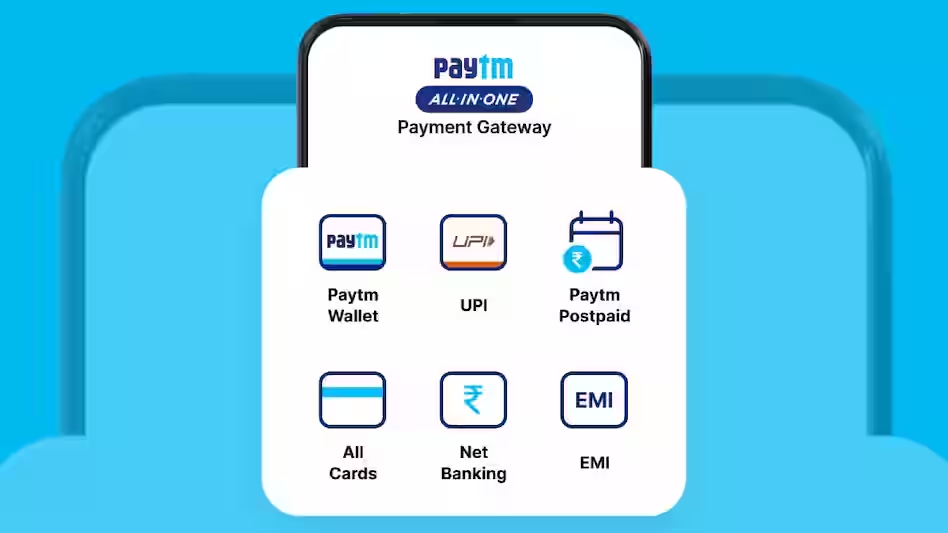
Let’s be direct about 2024: Paytm went through an RBI action that shook its banking unit. But the payment gateway arm has continued operating and onboarding merchants. The wallet user base, despite everything, remains massive in Tier 2 and Tier 3 markets.
Technical Specs Worth Knowing:
- Supports Paytm Wallet, UPI, cards, netbanking, and Paytm Postpaid (BNPL)
- JavaScript SDK and mobile SDKs for Android and iOS for native app integration
- Paytm for Business dashboard includes QR-based offline payment tracking
- Checksum-based API authentication for request verification
- Webhook notifications with retry logic for failed delivery attempts
- Payment link generation via API without requiring a full checkout integration
- Real-time transaction status polling and callback support
My honest recommendation: use it as a secondary gateway for wallet coverage in smaller cities rather than primary transaction infrastructure. The compliance picture is still settling, and running your core card and UPI volume through a cleaner stack makes sense until it does.
5. CCAvenue
CCAvenue is India’s oldest surviving payment gateway, and it knows exactly who it serves: traditional businesses, educational institutions, travel companies, and government-adjacent projects.
Technical Specs Worth Knowing:
- Over 200 payment options across domestic cards, international cards, wallets, netbanking, and EMI
- Multi-currency processing in 27+ foreign currencies with real-time conversion
- AES-256 encryption for all transaction data with RSA key-based API authentication
- A retry mechanism is built into checkout to reduce drop-offs from bank timeouts
- Batch transaction processing for offline/bulk order scenarios
- Fraud detection system with configurable risk rules per merchant
- Detailed chargeback management portal with dispute tracking
The API requires more implementation effort compared to modern alternatives, and the interface looks dated. But the breadth of payment options and enterprise compliance documentation makes it the default choice for institutional and government-facing projects.
6. Stripe

Stripe fully opened to Indian businesses after RBI compliance work through 2023-24. For businesses billing international customers, it’s genuinely excellent. The developer experience is arguably the best globally.
Technical Specs Worth Knowing:
- Stripe Elements and Stripe.js for highly customizable PCI-compliant checkout UI
- Native support for Indian payment methods: UPI, cards, netbanking via Stripe India entity
- Stripe Radar for ML-based fraud detection with customizable rule sets
- Webhooks with event versioning so API upgrades don’t break your integration
- Strong support for recurring billing via Stripe Billing with proration and trial period logic
- Stripe Connect for marketplace and platform payment splitting
- Supports INR settlements for Indian merchants; USD settlements available for international billing
Here’s my honest caveat: for purely domestic Indian transactions, Stripe’s pricing around 2% plus additional FX layers doesn’t beat local alternatives at 1.75-1.9%. For a SaaS billing for global clients, it makes complete sense. For an ethnic wear brand selling to Mumbai customers, probably not.
7. Instamojo

Instamojo solves a different problem from everyone else on this list. If you’re a course creator, freelancer, or small D2C brand doing under INR 10 lakh monthly, it cuts your setup friction dramatically.
Technical Specs Worth Knowing:
- Payment link generation via dashboard or API without requiring checkout code integration
- Mojostore for instant digital product storefronts (courses, PDFs, downloads)
- Webhook support for payment success/failure events with retry on failure
- Simple REST API with basic authentication, low implementation complexity
- Supports UPI, debit/credit cards, netbanking, and wallets
- Instant activation with minimal KYC compared to enterprise-grade gateways
- Mobile app for payment tracking and link generation on the go
Fees sit at 2% plus INR 3 per transaction, slightly higher than enterprise alternatives. But you’re paying for reduced technical overhead. Don’t try to scale a large business on this. As a starting point or a channel-specific payment tool, it serves its audience honestly.
8. Juspay

Juspay operates primarily as a payment orchestration layer rather than a standalone gateway. Large platforms like Amazon, Swiggy, and Dunzo use it to manage routing across multiple gateways simultaneously.
Technical Specs Worth Knowing:
- HyperCheckout: a unified checkout SDK that aggregates multiple gateway integrations under one interface
- Intelligent routing engine distributes transactions across gateways based on real-time success rate, cost, and bank health
- Express Checkout with saved card tokenization compliant with RBI’s card storage guidelines
- Unified analytics dashboard showing gateway-wise success rates, failure reasons, and latency
- Retry orchestration automatically reroutes failed transactions to backup gateways
- Supports A/B testing of checkout flows natively within the platform
- UPI deep links and intent flow support for seamless mobile UPI experience
For most small and mid-size businesses, this is overkill. But if you’re a fintech startup wondering why your payment success rate sits at 87% when it could reasonably be 93-94%, Juspay is worth a serious conversation.
9. PhonePe Business

PhonePe’s business gateway is primarily useful for UPI-heavy transaction environments, particularly businesses with an offline footprint or quick-commerce adjacent models.
Technical Specs Worth Knowing:
- Dynamic QR code generation via API with merchant-specific transaction tagging
- UPI intent and collect flow support for both app-to-app and browser-based payments
- PhonePe Switch SDK for in-app UPI payment integration on Android
- Real-time payment confirmation callbacks via webhook
- Merchant dashboard with daily settlement reports and UPI transaction breakdowns
- Supports split QR for multi-location businesses with location-wise tracking
- PG APIs are available for card and netbanking, though not as robust as the core UPI infrastructure
Card processing, international payments, and subscription billing aren’t its strengths. Think of it as a UPI-first tool rather than a complete payment stack. For kirana-adjacent businesses and local services, UPI settlement timelines are reliable, and setup is genuinely straightforward.
10. Easebuzz
Easebuzz carved out a strong position in sectors that other gateways don’t prioritize: educational institutions, nonprofits, cooperative societies, and state government projects.
Technical Specs Worth Knowing:
- Fee collection module with student/parent-facing payment links and automated receipt generation
- Multi-bank settlement routing so institutions can split collections across different accounts
- NACH and e-mandate support for recurring fee collection and donation subscriptions
- Detailed MIS reports with transaction-wise GST breakdowns for compliance filing
- Refund API with configurable approval workflows for institutional finance teams
- Supports UPI, cards, netbanking, wallets, and NACH mandates under one integration
- Webhook alerts with customizable event triggers for payment events and settlement reports
Transaction costs are competitive, and their customer support response times are notably better than what you’d expect from a company of their size. The product won’t win design awards, but it genuinely understands sector-specific compliance requirements that larger gateways treat as afterthoughts.
How to Choose the Right Payment Gateway?
So which one do you pick? Here’s my honest framework based on actual business type:
Tech-first startup or D2C brand: Razorpay as primary, Cashfree for bulk payouts. The integration effort pays off fast.
Large enterprise or marketplace: Juspay for orchestration over PayU or Razorpay. The success rate gains at scale justify the complexity.
Heavy Tier 2/3 market presence: Add Paytm wallet as a secondary channel regardless of your primary gateway. The conversion impact in those markets is measurable.
Primarily global billing: Stripe for subscription and international card handling, especially in USD or EUR.
Early-stage or solo business: Instamojo or Razorpay basic plan. Don’t over-engineer payment infrastructure until volume justifies it.
Education, nonprofit, or government-adjacent: CCAvenue and Easebuzz understand your reporting and compliance requirements better than the flashier options.
One thing that rarely gets said clearly: gateway fees aren’t the only cost. Factor in failed transactions, chargeback dispute support, settlement speed (T+1 vs T+3 affects your working capital), and integration maintenance. A gateway charging 0.1% less but failing 3% more transactions isn’t actually cheaper.
Test before you commit. Every serious gateway offers a sandbox. Run your actual transaction flows through it. Check what the failed payment experience looks like for your customer. That last part matters more than most people realize.

- 10 Best Payment Gateways for Indian Businesses - March 25, 2026
- Notion vs Trello: A Beginners Guide - March 24, 2026
- 10 Best Free VPN Services in 2026 - March 23, 2026