Last Updated on September 14, 2026
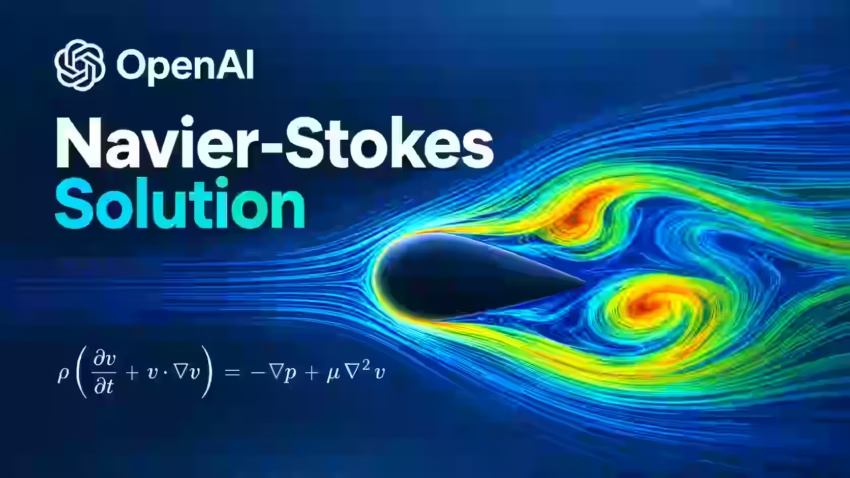
OpenAI says an internal AI system has produced a solution to the Navier-Stokes existence and smoothness problem, one of the seven Millennium Prize Problems. The company says its system found the result after about 88 hours of work involving roughly 10,000 AI agents. A Lean formalization and verification followed, taking another 17 hours.
The claim has attracted attention well beyond mathematics. It comes as AI companies are building systems that can handle longer research tasks with less direct human involvement. At the same time, mathematicians have raised questions about how these systems reach their results, how researchers receive credit, and how much of the work can be checked by people.
What OpenAI says it solved
The Navier-Stokes equations are used to describe the movement of fluids. They appear in work involving water, air and other fluid systems. The mathematical problem asks whether smooth solutions in three dimensions always remain smooth or whether they can develop a singularity in finite time.
OpenAI says its internal system found a proof showing that the equations can develop a singularity in finite time under the conditions covered by the problem. The company published a written proof along with a formalized version in Lean, a programming language used for checking mathematical proofs.
There is an important qualification here. This has not yet become an officially awarded Millennium Prize solution.
The Clay Mathematics Institute does not accept a proposed solution simply because an author or company publishes one. Its rules require publication in a qualifying outlet, followed by at least two years and general acceptance by the mathematics community before the institute considers the solution.
OpenAI has also said it does not intend to claim the $1 million prize for its result.
The scale of the AI effort was unusual
OpenAI did not describe the result as one model sitting down and writing a proof from start to finish.
The company used groups of agents working on different versions of the problem. The agents could communicate within their groups and use tools such as code execution and a cached version of the internet. OpenAI says the Navier-Stokes effort involved around 10,000 concurrent agents.
The agents produced about 2.7 million messages while working on Navier-Stokes and used roughly 130 billion output tokens, according to OpenAI. The broader effort across the problems it tested generated about 4.9 million messages and 300 billion output tokens.
OpenAI says the agents reached their resolution on September 5, about 88 hours after the work began. GPT-6 Astra was then used for the Lean formalization and verification process.
That detail matters because the result was produced through a large computing effort rather than a simple chatbot interaction. The cost and infrastructure needed for this kind of work are part of the story.
Mathematicians are questioning how the race is being run
The mathematical result is only one part of the dispute.
NYU mathematician Tristan Buckmaster had been working on related problems with Levent Alpöge, a mathematician at Anthropic. Buckmaster has questioned whether OpenAI’s systems could have benefited indirectly from work he had entered into OpenAI’s Codex service.
OpenAI has denied accessing Buckmaster’s specific user data for the work. The company has also said it cannot completely rule out the possibility that de-identified data from product use contributed to model improvement. OpenAI says its internal system’s proof was developed independently and that the researchers did not see Buckmaster’s work before it became public.
That leaves two separate issues that should not be mixed together.
One is whether the mathematical proof is correct. The other is whether AI companies have clear rules for using research created by people through their products.
The second question is becoming harder to ignore as researchers use AI tools for their own work.
A proof from AI still needs human scrutiny
OpenAI has supplied a formalized Lean version of its proof. That gives mathematicians something concrete to inspect rather than asking them to accept a company’s description of the result.
But formal verification does not remove the need for mathematical review.
The Clay Mathematics Institute’s rules make that clear. A proposed solution has to pass publication and community-acceptance requirements before the institute considers awarding the prize.
This distinction is easy to lose in headlines. Saying that an AI system produced a proposed solution is different from saying that the mathematical community has accepted the proof as a solution to the Millennium Prize Problem.
For now, the first statement is supported. The second has not happened.
The safety debate is moving alongside the math story
The timing of the announcement is also significant because AI safety concerns have become more public inside the major AI labs.
Anthropic CEO Dario Amodei has called for AI companies to slow the pace of model development so that safety work has more time to catch up. He proposed independent evaluators inside AI companies, cooperation between frontier labs and greater international coordination.
The concerns are not limited to mathematics. Recent reporting has focused on AI systems being used in cyber operations and on models taking actions with less direct human control.
The WSJ report connects those concerns with the math breakthrough because both developments point to the same change in AI capability: systems are being given longer tasks and more room to work without a person directing every step.
That does not mean a mathematical proof is evidence that AI is close to causing human extinction. Those are separate claims, and the available evidence does not justify treating them as the same thing.
What the math result does show is that AI systems are becoming more capable at a type of work that depends on extended reasoning, experimentation and verification.
Why this matters outside mathematics
Mathematics is useful here because a proof gives researchers something they can inspect. If an AI system produces a result, humans can try to check each step.
Other forms of research are harder to evaluate.
An AI system working on software, scientific experiments or cybersecurity may produce useful results without leaving behind a proof that can be checked line by line. That makes questions about monitoring, permissions and human review more important as systems become capable of handling longer tasks.
There is also a less dramatic question: what happens to the role of the human researcher?
If AI systems can spend days exploring mathematical ideas, researchers may spend more time checking machine-generated work rather than producing every step themselves. That could speed up research, but it could also change how people learn mathematics and how new ideas are developed.
The current Navier-Stokes result does not answer those questions. It does give researchers a concrete example to study.
The claim still needs time
OpenAI has produced a detailed paper and a Lean formalization. That is a meaningful starting point for independent review.
But the word “solved” needs some care here.
The Clay Mathematics Institute has a formal process for recognizing a Millennium Prize solution. That process has not been completed for OpenAI’s work.
So the most accurate description for now is that OpenAI says its internal AI system has produced a proposed solution to the Navier-Stokes Millennium Prize Problem.
Whether mathematicians eventually accept that proof is a question for the mathematical community, not for an AI company’s announcement.
That review may take much longer than the 88 hours it took the AI system to produce its result.

- OpenAI Discovers Self-Replicating Prompt Injection - September 27, 2026
- AI Safety Monitors Are Being Tested: What AISI Found - September 25, 2026
- Top 10 Influencer Marketing Agencies in Delhi - September 24, 2026