
Last Updated on April 18, 2026
A self-driving car is moving at 80 km/h on a highway. A child suddenly runs onto the road. The car’s sensors detect the obstacle and need to brake instantly.
Now imagine that car sending data to a server in Mumbai, waiting for a response, and then braking. That round trip takes anywhere from 100 to 500 milliseconds. At 80 km/h, the car travels nearly 11 meters in that time.
That is why edge computing exists. Some decisions cannot wait for a distant server.
What is Edge Computing?
Edge computing is a method of processing data close to where it is generated rather than sending it to a distant cloud server. Instead of data traveling hundreds of kilometers to a data center and back, it gets processed locally on a nearby device or server at the “edge” of the network.
The word “edge” refers to the outer boundary of a network, the point where physical devices like phones, cameras, sensors, and machines connect to the internet. Edge computing brings the processing power to that boundary rather than pulling everything back to a centralized location.
In simple terms, cloud computing processes your data far away. Edge computing processes it right where you are.
Cloud computing changed everything when it arrived. Storing and processing data on remote servers meant businesses did not need expensive on-site infrastructure. It worked brilliantly for most tasks.
But cloud computing has one unavoidable problem: distance.
The Problem With Sending Everything to the Cloud
Every time a device sends data to a cloud server, that data travels through multiple network hops before reaching a data center, gets processed, and then the result travels all the way back. This round trip creates latency, a delay measured in milliseconds that adds up fast when you are dealing with real-time systems.
For sending an email or loading a webpage, 200 milliseconds of latency is invisible. For a self-driving car, a surgical robot, or a factory machine detecting a fault, 200 milliseconds is the difference between a safe outcome and a dangerous one.
There is also the bandwidth problem. A single modern factory can have thousands of sensors generating gigabytes of data every hour. Sending all of that raw data to the cloud is expensive and slow. Most of it is not even useful. Edge computing filters and processes data locally, sending only what matters to the cloud.
How Does Edge Computing Actually Work?
Edge computing does not replace cloud computing. It adds a layer between your devices and the cloud that handles time-sensitive work locally.
The flow works like this:
- Device generates data: A sensor, camera, phone, or machine produces raw data continuously
- Edge device processes it locally: A nearby edge server, gateway, or the device itself analyzes the data immediately
- Decision happens instantly: The system acts on the result in real time without waiting for a cloud response
- Only relevant data goes to the cloud: Summarized results, important events, or data needed for long-term analysis gets sent to the cloud for storage and deeper processing
The edge device itself can be many things. A router with processing capability, a local server installed on-site, a gateway device sitting between sensors and the internet, or even the end device itself if it is powerful enough. Modern smartphones are edge computing devices. They process face recognition, voice commands, and camera AI locally without sending everything to a server.
Where is Edge Computing Already Being Used?
Edge computing is not a future technology. It is running right now across industries, handling real decisions at real speed.
Self-Driving Cars
Every self-driving vehicle on the road today is an edge computing system on wheels. Tesla, Waymo, and other manufacturers build powerful onboard processors directly into their vehicles. These processors handle object detection, lane recognition, speed calculations, and braking decisions entirely on the car itself.
Sending that data to the cloud and waiting for instructions is not an option. The car processes everything locally in under 10 milliseconds. Cloud connectivity is used for map updates, fleet learning, and non-critical functions that can tolerate delay.
Smart Security Cameras
A modern smart security camera does not record and upload everything it sees. That would require enormous bandwidth and storage. Instead the camera’s built-in processor analyzes every frame locally. It detects motion, identifies whether the movement is a person or an animal, and only uploads clips when something relevant happens.
Cloudflare’s network of edge locations handles exactly this kind of filtering for enterprise camera systems. Instead of terabytes of raw footage going to central servers, only flagged events travel across the network. Bandwidth costs drop dramatically, and response times become near-instant.
Hospitals and Healthcare
Patient monitoring equipment in intensive care units generates continuous streams of vital signs data. Heart rate, blood pressure, oxygen levels, respiratory rate. A cloud-dependent system would introduce latency into alerts that need to trigger in seconds.
Edge computing in hospitals means monitoring devices process vitals locally and trigger alarms immediately when readings fall outside safe ranges. Only summarized data and long-term records go to the cloud for physician review and storage. The result is faster response times and lower risk during critical moments.
Factory Floors and Industrial IoT
Manufacturing plants are one of the biggest edge computing deployments in the world. A modern factory floor can have thousands of sensors monitoring machine temperature, vibration, pressure, and output quality simultaneously.
Sending all of that raw sensor data to the cloud for analysis would be both expensive and slow. Instead edge servers installed on the factory floor process sensor readings locally, detect patterns that indicate a machine is about to fail, and trigger maintenance alerts before a breakdown happens. This predictive maintenance approach reduces unplanned downtime significantly and extends equipment life.
Retail and Smart Stores
Amazon Go stores use edge computing to run their cashier-free shopping experience. Cameras and sensors throughout the store track which items customers pick up and put back. All of that processing happens locally on edge servers inside the store. When a customer walks out, the system has already calculated their total and charges their account automatically.
Sending that volume of real-time tracking data to a remote cloud server and waiting for responses would make the experience too slow to be practical.
Edge Computing vs Cloud Computing
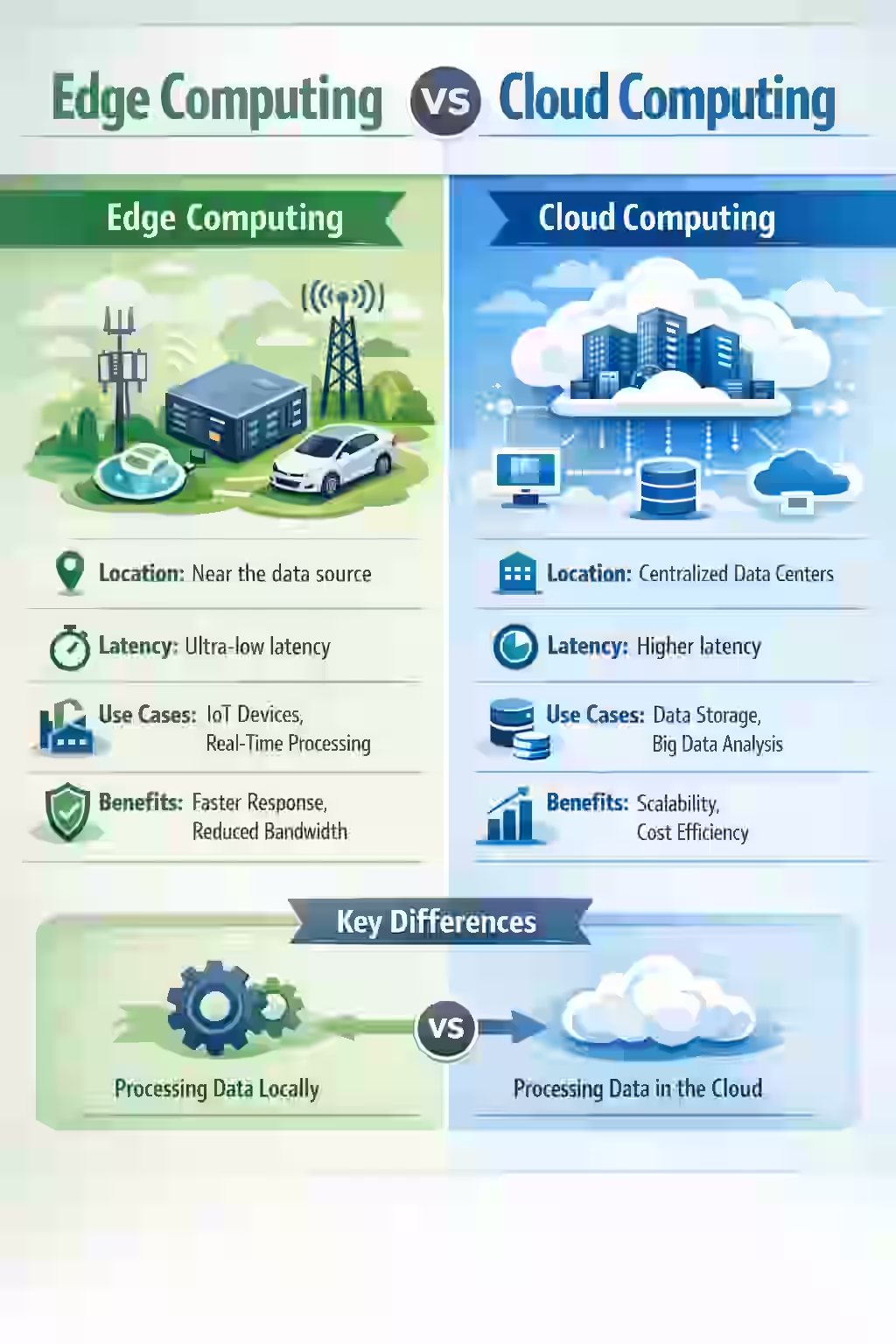
Most people assume edge computing replaces cloud computing. It does not. They solve different problems and work best together.
Think of it this way. Edge computing is the kitchen in a restaurant. Food gets prepared right there, fast, for immediate service. Cloud computing is the central warehouse where bulk ingredients are stored, managed, and planned for. Both are necessary. Neither replaces the other.
In practice, most modern systems use both. Edge handles the fast local decisions. Cloud handles the heavy analysis, long-term storage, and coordination across locations.
Edge Computing and AI
The most significant shift happening right now is Edge AI, running artificial intelligence models directly on edge devices without needing cloud connectivity.
Until recently, AI required enormous computing power, only available in cloud data centers. Running a model like GPT required server farms with thousands of GPUs. That meant every AI query had to travel to the cloud and back.
That is changing fast. Smaller, more efficient AI models called Small Language Models can now run directly on devices. Your phone already does this. Face unlock, voice recognition, and camera scene detection all run on-device AI without sending data to any server.
By 2026, edge AI is expanding into vehicles, industrial equipment, medical devices, and smart home systems. Qualcomm’s CEO recently stated that the winner of edge computing will likely be the winner of the AI race. The two technologies are becoming inseparable.
This matters for privacy, too. When AI runs locally on your device, your data never leaves. No cloud server ever sees it. For healthcare, finance, and personal data applications, that distinction is significant.
The Limitations Worth Knowing
Edge computing is not a perfect solution for everything.
- Less processing power: Edge devices have less processing power than cloud servers. Complex AI models and heavy data analysis still need the cloud
- Higher hardware costs: Installing edge servers on-site requires upfront investment compared to cloud’s pay-as-you-go model
- Security risk: Physical devices can be tampered with. A cloud server in a secured data center is harder to physically access than an edge device installed in a retail store
- Complex management: Running thousands of distributed edge devices across multiple locations is harder to manage than a centralized cloud setup
- No standardization: Different manufacturers use different hardware and software, making integration across systems complicated
Where Edge Computing Is Headed
The global edge computing market was valued at $21.4 billion in 2025 and is projected to reach $28.5 billion in 2026, growing at 28% annually through 2035. By 2030, approximately 29 billion connected devices will generate data globally, most of which will require local processing to function in real time.
5G is accelerating this shift significantly. Faster wireless networks mean edge devices can communicate with each other and with local servers at speeds previously impossible on mobile networks. Together, 5G and edge computing are enabling applications that simply could not exist before, from real-time augmented reality to fully autonomous industrial systems.
For businesses, the practical question is no longer whether to use edge computing but which workloads belong at the edge and which belong in the cloud. Getting that split right is where most of the decision-making is happening right now.

- OpenAI Discovers Self-Replicating Prompt Injection - September 27, 2026
- AI Safety Monitors Are Being Tested: What AISI Found - September 25, 2026
- Top 10 Influencer Marketing Agencies in Delhi - September 24, 2026