

You ask your AI assistant to plan a business trip to Delhi. ChatGPT gives you a neat list of hotels, flight options, and things to do. Helpful, yes. But now you have to open fifteen tabs, compare prices, check availability, and book everything yourself.
An agentic AI system just books the entire trip.
That is not a marketing claim. That is the actual difference between what most people use today and what agentic AI is built to do. And in 2026, this is no longer a concept sitting in a research lab. It is already running inside tools that millions of people and businesses use every single day.
What is Agentic AI?
Agentic AI is an autonomous AI system that can perceive its environment, reason through a problem, make decisions, and take action on its own without needing step-by-step instructions from a human. You give it a goal. It figures out how to reach it.
Most people’s experience with AI is reactive. You type a prompt into ChatGPT, it responds, and then it stops. Every next step needs another prompt from you. It is essentially a very capable question-answering machine that only works when you talk to it.
Agentic AI works differently. It is proactive. Give it a goal, and it breaks that goal into steps, picks the right tools, handles obstacles along the way, checks its own work, and delivers a finished result. The human sets the destination. The AI drives the entire route.
Agentic AI vs Regular AI: The Real Difference
Think of it this way. Traditional AI is a calculator; it gives you output based on what you put in. Generative AI like ChatGPT is a writer; it creates content based on your prompt. Agentic AI is a project manager. It understands your objective, delegates tasks, uses tools, and completes the project.
That shift from answering to doing is what makes agentic AI a genuinely different category, not just a smarter chatbot with a new name.
How Does Agentic AI Actually Work?
Under the surface, every agentic AI system runs a continuous four-part loop until the goal is complete. Understanding this loop makes everything else about the technology easier to follow.
Perception
Before taking any action, the system collects data from wherever it is relevant. Your calendar, a company database, the internet, an API connected to another software tool. It builds a full picture of the current situation before making a single move. This environmental awareness is what separates an AI agent from a basic automation script that follows fixed rules regardless of context.
Reasoning and Planning
Once it has the context, the autonomous AI system analyzes the information, understands what needs to happen, and maps out a sequence of steps to reach the goal. If the goal is large, it is broken into smaller subtasks. If something unexpected comes up mid-task, it adjusts the plan rather than stopping and waiting for a human to intervene.
Action
This is where agentic AI takes over actual execution. It might search the web, write and run code, send an email, fill out a form, update a database, or trigger another connected system. All of this happens through tool integrations and APIs without a human clicking through each step manually.
Reflection
After each action, the system evaluates whether the outcome matched what was expected. If something went wrong or the result was off, it self-corrects and tries a different approach. This self-learning loop is what makes agentic AI genuinely different from any automation tool that existed before it. Most automation breaks the moment something unexpected happens. Agentic AI adapts.
Best Agentic AI Use Cases
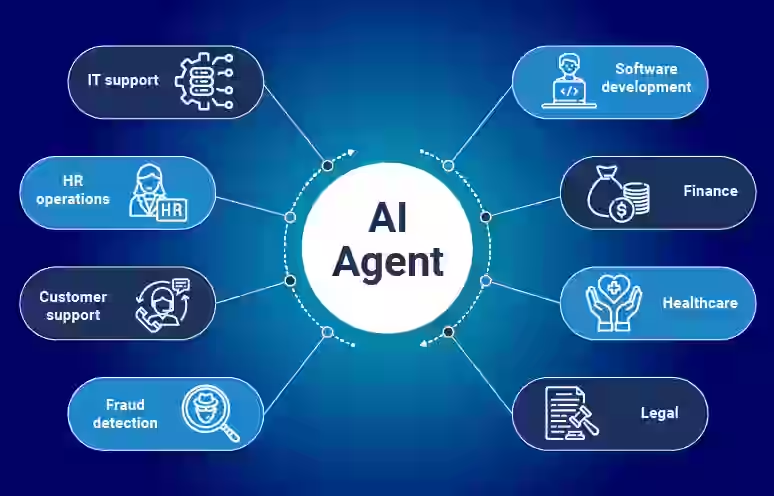
This technology is not waiting for the future. Real organizations are deploying AI agents today across industries and seeing measurable results. Here are four examples that show exactly what agentic AI looks like in practice.
Walmart
Walmart built an agentic AI system to handle inventory decisions autonomously across its supply chain. The system monitors stock levels, tracks regional demand patterns, detects signals like weather changes or viral product trends, and makes restocking decisions without waiting for a human analyst to review reports. The pilot produced a 22% increase in e-commerce sales in the regions where it ran, driven by better product availability and faster response to demand shifts.
GitHub Copilot Agent
GitHub’s Copilot moved well beyond suggesting lines of code. In agent mode, it can scan a codebase for bugs, write the fixes, run automated tests to confirm the fix works, and submit a pull request for a human developer to review and approve. Tasks that used to take a developer hours of repetitive work now get handled autonomously, freeing the team to focus on architecture and judgment-based decisions instead.
Ramp
Ramp, a corporate finance platform used by over 40,000 businesses, launched an AI finance agent in 2025 that reads company expense policy documents, audits transactions autonomously, flags policy violations, generates reimbursement approvals, and coordinates with procurement systems to verify vendor compliance. The entire workflow runs without a finance team member reviewing each line item manually.
Salesforce Agentforce
Salesforce’s Agentforce platform has been deployed by organizations, including government agencies and public sector bodies to resolve customer service queries end-to-end without a human agent getting involved. The system understands context, interprets natural language queries, and handles resolution from start to finish. Gartner projects that by 2029, agentic AI will autonomously resolve 80% of common customer service issues, cutting support costs by 30%.
The global agentic AI market reflects how fast adoption is moving. It was valued at $28 billion in 2024 and is projected to reach $127 billion by 2029, growing at 35% annually. Gartner also estimates that 40% of enterprise applications will include task-specific AI agents by the end of 2026, up from less than 5% in 2025.
Should You Be Excited or Worried About Agentic AI?
Both reactions are fair. Here is an honest take on what is genuinely useful and what deserves careful thought before you hand over full autonomy to any system.
What Makes It Worth Paying Attention To
Agentic AI is already making multi-step digital work significantly faster and less dependent on sustained human attention. Research, scheduling, data entry, expense audits, customer support, and inventory management. These are tasks that consume hours of repetitive human effort every week. A MIT and BCG survey from 2025 found that 35% of organizations have already adopted AI agents, with 44% more planning to follow within the next two years.
For small businesses and individual users, the practical benefit is straightforward. Tasks that required either hiring help or spending hours doing manually can now be delegated to an AI agent that runs continuously, does not miss deadlines, and does not need to be reminded.
What Deserves Honest Caution
The technology is moving faster than the governance frameworks designed to keep it safe. A 2025 survey found that 74% of IT leaders believe agentic AI introduces a new category of security risk. Because these systems connect to multiple tools, databases, and external services simultaneously, a compromised or misbehaving AI agent can cause significantly more damage than a compromised chatbot that only generates text.
There is also the explainability gap. When an autonomous AI system makes a decision, tracing exactly why it chose one path over another is often difficult. For low-stakes tasks like drafting emails or summarizing reports, that ambiguity is manageable. For decisions involving money, legal matters, or sensitive data, that lack of transparency is a real concern worth thinking through before deployment.
Only 15% of IT leaders currently feel confident enough to deploy fully autonomous agents in production environments. That number tells you something important about where enterprise trust actually sits right now, even as the marketing around agentic AI runs well ahead of it.
Where to Go From Here?
Agentic AI is not a shinier version of ChatGPT. It is a fundamentally different approach to what artificial intelligence can do, moving from generating responses to completing missions independently.
The practical entry point for anyone curious is to try one of the existing agentic tools in a low-stakes context first. See how it handles a real multi-step task from start to finish. That hands-on experience will tell you more about what agentic AI actually is than any amount of reading can.
The next post in this series covers the top agentic AI tools you can use right now, both free and paid, with an honest breakdown of what each one does well and where it still falls short.

- Best AI Tools for Tech Professionals- The Complete Guide - April 10, 2026
- 10 Best Business Software Stack for Startups - April 6, 2026
- Cloud Cost Management in 2026: FinOps Strategies That Work - April 5, 2026