
Quick Answer: Best Software Development Companies in the USA (2026)
The top software development companies in the USA in 2026 are Lemon.io, Rootstrap, Vetted, Striveworks, Booz Allen Hamilton, Slalom, Thoughtworks, WillowTree, Turing, and BairesDev. Each leads in a specific niche- from startup-speed product studios to AI/ML engineering to federal IT contracts. The right choice depends on your budget, project size, timeline, and technical requirements.
Why Finding the Right Software Development Partner Is Harder Than It Looks
A startup founder once described hiring a software development firm as “signing a lease on a house you’ve never walked through.” You see the portfolio, read the case studies, talk to a sales rep who really knows their stuff, and then six months later, the code is a mess, and the timeline has slipped by three months.
That experience is far more common than any company’s testimonial page will admit.
The US software development market is projected to exceed $650 billion by 2026, according to Statista, and the number of firms claiming to be “full-stack,” “AI-first,” or “agile-native” has multiplied fast. So sorting through them takes more than reading a list. It takes knowing what each firm actually does well, where it tends to cut corners, and which types of clients it genuinely fits.
This list is built on that logic. These are not the ten biggest companies by headcount. There are ten firms that have shown consistent delivery quality, honest specialization, and real-world track records across different kinds of projects.
The Top 10 Software Development Companies in the USA in 2026
1. Lemon.io

Best for: Startups, early-stage product companies, teams needing pre-vetted developers fast. Headquarters: Dover, DE (fully remote, US-operated) Team size: 700+ vetted developers in active network Pricing: $50–$150/hour depending on seniority and stack
Lemon.io launched in 2015 as a platform connecting startups with hand-screened remote developers, and it has built a quiet but solid reputation in the startup community. The core promise is speed without the lottery-style risk of unvetted freelancer marketplaces. According to Lemon.io’s own published data, over 95% of their developer matches result in a trial period that converts to a long-term engagement, a number that would be easy to dismiss if the platform’s Clutch reviews didn’t back it up consistently [Lemon.io, 2025].
What makes Lemon.io genuinely useful in 2026 is its specialization in early-stage product work. This is not a place to go if you need a 50-person team building enterprise infrastructure. It is exactly the right place if you are a three-person startup that needs a senior React developer or a backend engineer with solid Node.js experience within two weeks.
The vetting goes beyond a coding test. Lemon.io screens for communication skills and async work habits, which matter more than most founders realize when working with remote developers across time zones. A bad communicator who writes great code will still slow your product down.
For companies building out their first software product, understanding what agentic AI use cases for business automation look like in practice helps set realistic expectations for what modern software can and should do at the product level.
2. Rootstrap
Best for: Startups, scale-ups, mobile and web product development, growth-focused tech companies. Headquarters: Los Angeles, CA (with teams in Uruguay and Argentina) Team size: 300+ engineers and designers. Pricing: $75–$160/hour; project-based pricing available
Rootstrap was founded in 2011 and has built a strong client base among funded startups and growth-stage companies. Its work spans iOS and Android development, web platforms, and product strategy, and it has worked with recognizable names like Google and MasterClass, which is unusual credibility for a firm of its size.
What separates Rootstrap from the crowded startup-agency space is a genuine product mindset. Many agencies ask, “What do you want us to build?” Rootstrap typically asks “what outcome are you trying to create?” and works backward from there. It shows up in how they structure discovery phases and how willing they are to push back on the scope that doesn’t serve the actual goal.
Human insight: A founder building a wellness app described working with Rootstrap as the first time an agency told them their initial feature roadmap was too ambitious for a v1 launch. That conversation saved them four months of development time and probably a significant amount of runway. Honest pushback from a vendor is rarer than it should be.
Rootstrap’s nearshore model (US leadership, Latin American engineering) keeps pricing in a range that funded startups can actually work with. The timezone overlap with US teams is solid, and the communication culture skews toward over-communication rather than the opposite.
3. Vetted
Best for: Companies needing senior, specialized engineers fast; product teams with existing leadership. Headquarters: San Francisco, CA Team size: Growing network of 1,500+ senior developers. Pricing: $80–$180/hour; focused on senior-level placements
Vetted is a newer entrant. Founded in 2020, it has taken a sharply focused position in the market: only senior engineers, only rigorous screening, and no juniors filling mid-level roles. The platform uses a combination of technical interviews, take-home projects, and reference checks that reportedly take four to six hours of assessment per candidate. Less than 5% of applicants make it through [Vetted.ai, 2025].
The business model is built around the frustration that most hiring platforms mix signal with noise. When a company needs a senior Kubernetes engineer or a data architect with production ML experience, sifting through 200 applicants to find three qualified ones is a real cost. Vetted’s pitch is that the sifting is already done.
Good automation testing tools and DevOps practices only work when the engineers implementing them actually know what they’re doing. That’s the gap Vetted is specifically built to close.
The limitation is the same as any senior-focused talent network: price. If your budget is tight or you need a large team quickly, Vetted’s placement model is not the right fit. But for a company that needs one or two exceptional engineers placed inside an existing team, it is worth a serious look.
4. Striveworks
Best for: AI/ML engineering, MLOps, defense and government AI programs, enterprise AI deployment Headquarters: Austin, TX Team size: 200+ Pricing: Project-based and retainer; government contract pricing available
Striveworks is one of the more interesting companies on this list because it occupies a niche that barely existed five years ago: production AI engineering for high-stakes environments. The firm was founded in 2019 by former defense and intelligence community professionals, and it builds the kind of AI systems that actually have to work, military logistics platforms, intelligence analysis tools, and enterprise AI deployments where failure is not a recoverable error.
The firm’s flagship product, Chariot, is an MLOps platform designed for deploying and monitoring machine learning models in air-gapped and edge environments — a requirement that matters enormously in defense contexts and increasingly in healthcare and critical infrastructure. According to Striveworks’ published work, Chariot has been deployed on active US Department of Defense programs [Striveworks, 2025].
Human insight: The commercial AI market is full of companies that can build a demo. Striveworks is built around the much harder problem of keeping AI systems accurate and auditable in production, over time, in environments where data conditions change. That distinction is lost on most buyers until it isn’t — and by then the cost of the wrong choice is high.
For companies thinking about where AI development intersects with business automation, the depth of agentic AI platforms available today shows how quickly the space has matured and why specialized firms like Striveworks are carving out real ground.
5. Booz Allen Hamilton

Best for: US federal government, defense, intelligence community, public sector. Headquarters: McLean, VA Team size: 33,000+ Pricing: Government contract rates; not available for commercial private-sector work
Booz Allen Hamilton is not trying to compete with Accenture for Fortune 500 commercial clients. Its entire business is built around US government technology work, defense systems, intelligence platforms, public health IT, and civilian agency modernization. If you’re a federal contracting officer or working within a government program that needs software development, Booz Allen is likely already on your approved vendor list.
The firm’s security clearance coverage is unmatched. It holds thousands of cleared employees working on classified and sensitive programs, which is a capability that commercial firms simply cannot replicate. According to its 2024 annual report, over 97% of Booz Allen’s revenue comes from US government clients, which tells you exactly who this firm is built for [Booz Allen Hamilton Annual Report, 2024].
6. Slalom
Best for: Mid-market companies, technology strategy, Microsoft, and Salesforce ecosystems. Headquarters: Seattle, WA. Team size: 13,000+. Pricing: Mid-market to enterprise; more accessible than the Big 4 consulting firms
Slalom sits in a useful middle ground, bigger than a boutique agency, smaller than Accenture, and consistently rated highly by the clients who use it. It operates a local market model, meaning teams are based in the same cities as their clients rather than flying in from a central hub. That sounds like a minor detail, but it changes the quality of the working relationship considerably.
Slalom specializes heavily in Microsoft, Salesforce, and AWS ecosystems. For a company doing a Dynamics 365 implementation or building a custom application on top of Salesforce, Slalom often delivers better results than larger firms at a fraction of the enterprise contract size.
The project management side of Slalom engagements is consistently praised. If you’re managing internal software projects alongside vendor-delivered work, pairing good project management tools with a delivery firm like Slalom keeps the whole effort from fragmenting.
7. Thoughtworks
Best for: Agile software delivery, product engineering, and distributed team building. Headquarters: Chicago, IL Team size: 10,000+ globally Pricing: Premium; positions itself as a high-quality boutique at scale
Thoughtworks has one of the strongest engineering cultures of any firm on this list. It helped pioneer agile delivery practices before “agile” became a buzzword, and it still runs leaner, more disciplined teams than most of its competitors. The firm publishes the Technology Radar. A quarterly report on technology trends that has become a genuine reference document for engineering leaders globally, which gives you a sense of how seriously it takes actual engineering thinking [Thoughtworks Technology Radar, 2025].
Thoughtworks fits best with clients who have internal product teams and want an outside partner who will challenge assumptions, not just execute tickets. If you want a vendor who will raise uncomfortable questions about architecture decisions and help you build internal capability rather than dependency, Thoughtworks is worth a serious look.
Pairing a firm like Thoughtworks with a solid DevOps toolset on your side accelerates delivery and avoids the common trap where vendor-built code is impossible for internal teams to maintain after handoff.
8. WillowTree
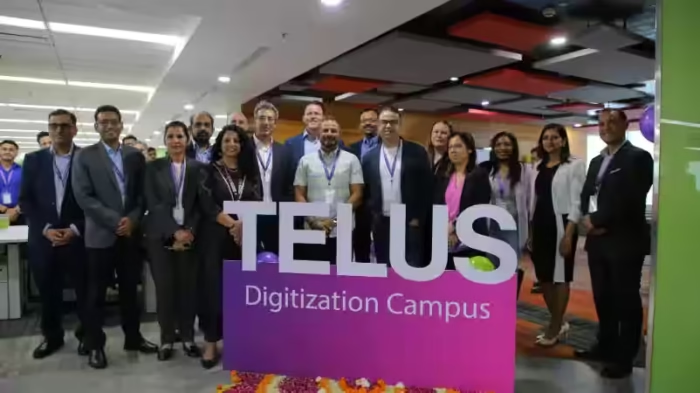
Best for: Mobile app development, consumer-facing digital products, UX-intensive projects Headquarters: Charlottesville, VA (with offices in Durham, Columbus, and New Orleans) Team size: 1,000+ Pricing: Premium boutique rates; typically $200–$350/hour
WillowTree sits in a different lane than the enterprise firms above. It is a product-focused studio that builds mobile and web applications for brands where the user experience actually matters. Its client list includes Pepsi, HBO, Synchrony Financial, and Johnson & Johnson — companies where the app is the product, not just a backend interface.
What WillowTree does particularly well is the intersection of design and engineering. Most development firms treat design as a phase that happens before development starts. WillowTree runs them in parallel, which produces more realistic products faster and avoids the classic problem where a beautifully designed prototype becomes a mediocre app once the engineers get to it.
9. Turing

Best for: Startups and scale-ups, on-demand engineering talent, and AI-matched developer placement. Headquarters: Palo Alto, CA Team size: 3 million+ vetted developers in network Pricing: From $30–$100+/hour depending on role and seniority
Turing is not a traditional software development firm. It is a talent platform that uses AI matching to connect companies with vetted remote software engineers from around the world, managed through a US entity. For startups that need development speed without the overhead of a large consulting engagement, Turing fills a real gap.
The vetting process is rigorous — reportedly less than 2% of applicants pass Turing’s technical screening [Turing.com, 2025]. That matters because the common pain point with freelance developer platforms is inconsistency. Turing reduces that by pre-qualifying engineers before they ever reach a client.
The limitation is straightforward: Turing gives you engineers, not a product team. You still need someone internally who can define requirements, manage sprints, and make product decisions. If your organization has that leadership and needs execution capacity quickly, Turing makes a lot of sense. For businesses also building out AI-powered workflows, resources on agentic AI platforms show how the development landscape itself is shifting.
10. BairesDev
Best for: Tech companies, scale-ups, startups needing nearshore engineering teams. Headquarters: San Francisco, CA (operations across Latin America) Team size: 4,000+ engineers Pricing: $35–$80/hour; significantly lower than US-based boutique firms
BairesDev operates on a nearshore model. Most of its engineers are based in Latin America, which means US timezone alignment without the full cost of a domestic team. The quality bar is higher than most nearshore alternatives because BairesDev claims to hire only the top 1% of tech talent in its network, and its client list includes Google, Pfizer, and Pinterest.
The honest picture: nearshore always involves some coordination overhead. Code review cycles, daily standups, and technical handoffs work smoothly, but nuanced product discussions sometimes require more preparation than they would with a co-located team. Teams that have clear requirements and structured sprint processes get the most out of BairesDev. Teams still figuring out what they’re building may find the remote model frustrating.
For companies whose software development touches sensitive business systems, building a complete cybersecurity toolkit before you onboard any external development partner is a step that gets skipped more often than it should be.
Quick Comparison: Which Firm Fits Your Situation
What to Look for Before You Sign:
Most bad vendor relationships follow the same pattern. The discovery phase goes well. Everyone is aligned. Then delivery starts, and the communication gets sparse, the code quality drifts, and by the time the problem is obvious enough to act on, months have passed.
A few things that actually help prevent that:
Ask for a sample code review. Any firm confident in its work will agree to this. Have your own engineer review a codebase from a recent engagement. You can learn more in one hour of code review than in three weeks of sales calls.
Check who is actually on your project. The people you meet during the sales process are rarely the people who write your code. Ask specifically who will be assigned, what their seniority level is, and what percentage of their time they’ll give your project.
Agree on documentation from day one. Software that isn’t documented is a liability the day the vendor relationship ends. This is especially true when a tool like a business software stack relies on custom integrations that only the vendor fully understands.
Define what “done” means before you start. Acceptance criteria, testing requirements, and handoff conditions should be in the contract. Not in an email. Not in a Slack thread. In the contract.
Conclusion
There is no single best software development company in the USA. There is only the right one for your specific project, your team’s capacity, and your budget. Lemon.io and Vetted solve the problem of finding quality engineers fast without the noise of open marketplaces. Rootstrap and Striveworks bring genuine product and AI depth that most agencies in their size range cannot match. Slalom and Thoughtworks fit companies that want smart partners with strong engineering discipline. WillowTree is the call when the product experience genuinely matters. Turing and BairesDev exist for teams that need capable engineers fast without full agency overhead.
Frequently Asked Questions
Lemon.io, Rootstrap, Vetted, and Striveworks are all relatively young US firms gaining real traction in 2026 for startup product builds, senior engineer placement, and specialized AI/ML development work.
Costs range from $35/hour for nearshore talent platforms like BairesDev to $180/hour for senior-focused networks like Vetted. Specialized AI firms like Striveworks typically work on project or government contract terms.
A development company delivers complete products or systems and owns outcomes. A staffing agency provides individual engineers who work under your direction. Turing and BairesDev sit closer to the staffing model with some managed service elements.
Lemon.io and Rootstrap are strong choices for startups. Lemon.io places pre-vetted developers quickly; Rootstrap offers full product studio support with a nearshore cost model that funded startups can realistically afford.
Reliability depends on the firm’s vetting process, your internal project management, and how clearly requirements are defined. Firms like BairesDev and Cognizant have proven track records with Fortune 500 clients despite offshore or nearshore delivery.
Request a sample code review from a past project, ask for client references in your industry, confirm who specifically will be assigned to your project, and review their documentation and testing practices before signing.
Nearshore development means working with engineering teams in neighboring countries — typically Latin America for US companies — that share similar time zones, reducing the coordination friction of fully offshore (Asia-based) teams.

- Top 10 Software Development Companies in the USA - April 11, 2026
- 10 Best Cloud Storage Solutions for Businesses - April 10, 2026
- Best EDR Tools for Small Business in 2026: Tested & Ranked - April 9, 2026