It’s your first week at a new job. Everyone around you is casually tossing around words like “Kubernetes clusters,” “Terraform modules,” and “ArgoCD pipelines.” You’re nodding along, smiling, internally panicking. If you’re trying to break into DevOps or figure out which DevOps tools are actually worth learning in 2026, this list is your starting point. Not a generic rundown. A practical breakdown of the best DevOps tools for engineers, why each one matters, and how to think about building your skills around them.
Quick context:
The DevOps market hit $19.57 billion this year, projected to reach $51.43 billion by 2031. Average salaries for DevOps engineers sit around $143,372 annually in the US, with senior roles in San Francisco crossing $174,000. DevOps is literally the 5th most demanded technical profession globally right now. The tools you pick up directly shape what you earn.
Why These DevOps Tools Matter in 2026?
Organizations using mature DevOps practices report 200% higher deployment frequency and a 50% drop in time-to-market. Amazon’s engineers deploy code every 11.7 seconds. Netflix built an entire suite of DevOps automation tools just to find and kill vulnerabilities inside their own systems. These aren’t unicorn companies doing magic. They’re just disciplined about their tooling.
81% of organizations have already adopted or are actively planning to adopt DevOps practices. If you’re not learning these tools, someone else already is.
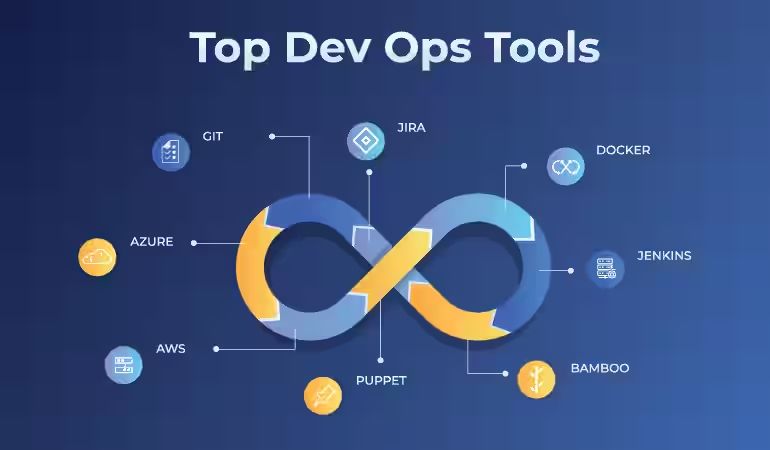
The 10 essential DevOps tools below cover six core areas: version control, containers, orchestration, infrastructure as code, CI/CD pipeline tools, monitoring, and security. Learn them in roughly that order, and you’ll have a genuinely complete foundation.
The Foundation Layer
1. Git
Nothing works without this. Git is the bedrock of modern software development, and if you’re skipping it because it “sounds basic,” you’re going to hit walls everywhere else. Every DevOps tool on this list assumes you’re comfortable with Git workflows.
Over 100 million developers use GitHub alone. Git gives you branching, pull requests, and distributed development across teams. It integrates directly with VS Code, IntelliJ, Eclipse, and practically every CI/CD pipeline tool you’ll encounter. Basics take a week or two. Mastering it takes months of real usage.
Think of Git like muscle memory. The more you use it, the less you think about it, and that’s exactly where you want to be.
2. Docker
Before Docker, the classic nightmare was mismatched environments. Your local setup, staging, and production all behaved differently. Docker solved this by packaging an application with everything it needs inside a container. Same environment, everywhere, every time.
Docker is central to modern DevOps automation. Docker Hub is the largest container registry out there, and 83% of developers carry out DevOps activities daily with containerization at the core. The free Community Edition is enough to get started. The more important thing to know: Docker is the foundation that makes Kubernetes possible. You genuinely can’t understand container orchestration without first getting your hands dirty here.
Orchestration and Infrastructure
3. Kubernetes
Here’s the deal with Kubernetes: it’s hard. And it’s also completely unavoidable. HackerX ranked it the single most in-demand DevOps skill heading into 2026. Container orchestration with Kubernetes is what separates junior DevOps profiles from senior ones on almost every job posting you’ll see this year.
What it actually does is manage your containers at scale. Automated scaling when traffic spikes, load balancing across servers, and restarting containers when they crash. All of it, hands-free. The major cloud platforms, AWS EKS, Google GKE, and Azure AKS, are all Kubernetes-based, and 94% of enterprises already use cloud services for scalability.
Want to stand out? Go beyond the basics. Learn Helm charts, get familiar with Istio for service mesh networking, and understand multi-cluster management. That’s where senior-level Kubernetes conversations happen.
4. Terraform
Infrastructure as code is one of those ideas that sounds complicated but clicks fast once you see it in action. Instead of manually clicking through cloud consoles to provision servers and networks, you write code that describes what you want. Terraform builds it.
HackerX confirmed Terraform remains the dominant IaC tool in 2026, and Mordor Intelligence reports 70% of enterprises are deploying infrastructure as code. It cuts deployment failures by roughly 40% and supports AWS, Azure, and GCP with the same declarative syntax, making it the go-to choice for multi-cloud environments.
Worth knowing: Pulumi is growing as an alternative for teams that prefer Python or TypeScript over Terraform’s HCL syntax. But for now, Terraform is what employers are hiring for.
5. Ansible
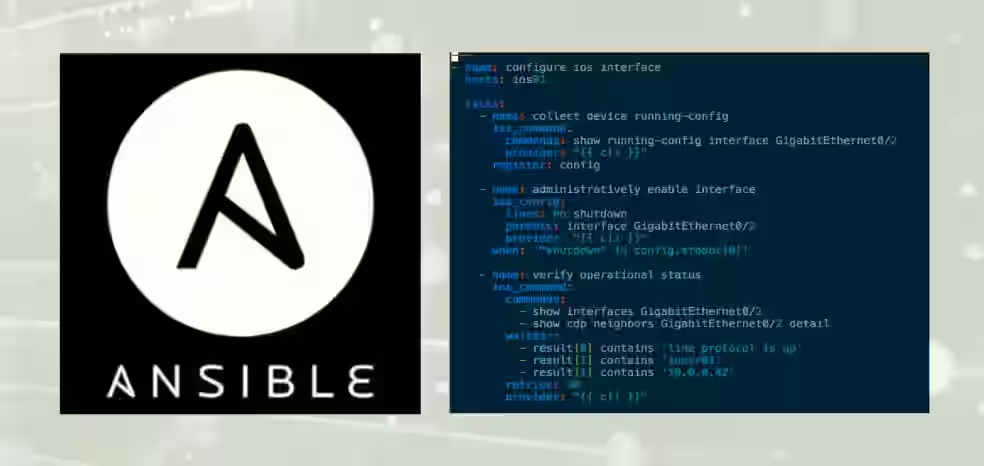
Ansible handles configuration management, which is making sure your servers are set up exactly the way you want, consistently, every time. What makes it stand out among configuration management tools is that it’s agentless. No software to install on target systems. It connects over SSH and gets to work.
Playbooks are written in YAML, readable even for beginners. Maintained by Red Hat, free to use. The honest trade-off: Ansible can be slower than Puppet or Chef at a very large scale. For most teams, though, it hits the right balance of simplicity and real power. It also handles application deployment and broader DevOps automation tasks beyond just configuration.
CI/CD Pipeline Tools and Delivery
6. Jenkins
Jenkins has been around since 2011, and it’s still standing, which says a lot. It’s the open source CI/CD automation server with over 1,800 plugins. Written in Java, free to use, and deeply embedded in enterprise environments worldwide.
CI/CD pipeline tools like Jenkins are exactly why Amazon can deploy code every 11.7 seconds. Jenkins shines in complex enterprise setups where you need custom, highly specific automation. Its biggest strength is flexibility. Its biggest weakness is maintenance overhead. It requires dedicated attention to keep running smoothly, which is why some teams shift to GitHub Actions for simpler projects. But for sophisticated pipelines, Jenkins still wins.
7. GitLab CI/CD
If Jenkins is the veteran, GitLab CI/CD is the modern all-in-one alternative. GitLab’s pitch is simple: get your entire DevOps lifecycle, source control, CI/CD pipelines, security scanning, deployment, and monitoring, inside a single platform.
For teams tired of stitching together five different tools, this is genuinely appealing. The free Community Edition covers serious ground. GitHub Actions is the direct competitor, and which one you choose often comes down to where your code already lives. Both are solid CI/CD pipeline tools for 2026. GitLab edges ahead when teams want everything unified.
8. ArgoCD
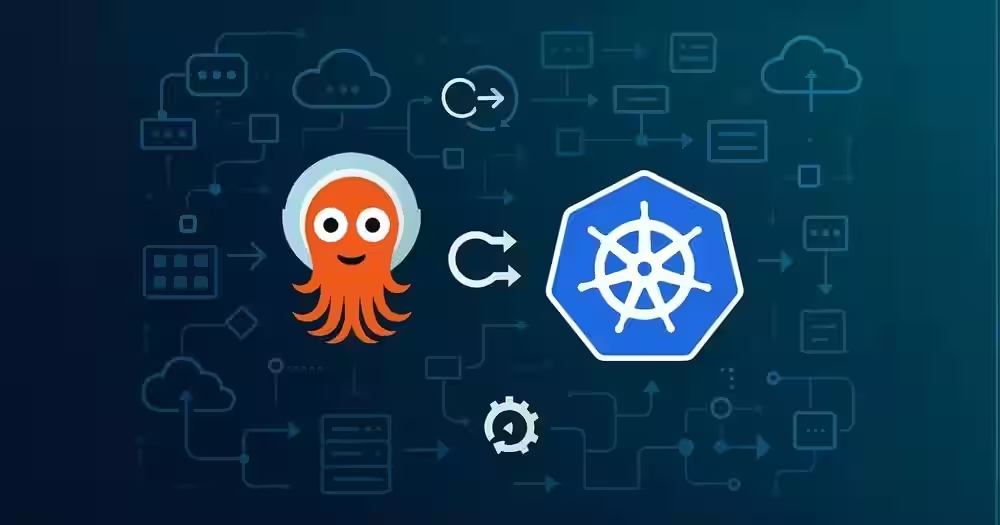
ArgoCD is more specific than the others here, but its rise has been fast and deliberate. It’s a GitOps continuous delivery tool built specifically for Kubernetes. GitOps means your Git repository becomes the single source of truth for your entire infrastructure state. When something changes in Git, ArgoCD automatically syncs it to your Kubernetes cluster.
Free, open source through CNCF, and HackerX specifically listed it alongside GitHub Actions and Jenkins as a top CI/CD tool for 2026. If your team runs Kubernetes, ArgoCD is quickly shifting from an optional add-on to a standard practice.
Monitoring, Observability, and DevSecOps Tools
9. Prometheus and Grafana

These two are almost always mentioned together because they complement each other. Prometheus collects metrics from your systems and stores them for alerting. Grafana takes that raw data and turns it into dashboards you can actually read and act on.
Both are free and open source. Together, HackerX calls them part of “the modern observability stack” alongside Datadog and OpenTelemetry. They’re Kubernetes-native, which matters enormously in 2026 infrastructure setups. One real limitation worth knowing: Prometheus wasn’t designed for long-term metric storage. For months or years of historical analysis, pair it with Thanos or Cortex.
55% of DevOps teams can fix a published error within a week. Teams with mature observability tooling get that down to 39% within a single day. Prometheus and Grafana are a big reason why.
10. HashiCorp Vault
Security gets treated as an afterthought more often than anyone wants to admit. In 2026, that mindset is actively hurting teams. Vault is a secrets management and DevSecOps tool that stores and controls access to passwords, API keys, tokens, and TLS certificates. The kind of sensitive credentials that absolutely shouldn’t live in a plain-text config file.
The shift toward DevSecOps, moving security earlier into the development cycle rather than bolting it on at the end, is what’s pushing Vault from “nice to have” to genuinely essential. HackerX flagged it as a critical DevSecOps tool this year. It integrates cleanly with Terraform, Kubernetes, and all major cloud providers. The open source version is free. Enterprise features require a paid plan.
Where to Start: A Practical Learning Path
Don’t try to absorb all 10 DevOps tools at once. That’s a fast track to burnout and shallow knowledge across the board.
Start with Git and Docker. Those two alone will open real doors. Then move into Kubernetes and Terraform together since they’re tightly connected in most modern infrastructure setups. Once you’re steady there, layer in Jenkins or GitLab CI/CD based on what your target employers actually use. Add Prometheus and Grafana for observability. Then round it out with Argo CD and Vault as you move toward senior-level work.
One last number worth sitting with: 37% of IT leaders say lack of DevOps skills is their biggest technical gap right now. And 29% of IT teams recently hired a DevOps engineer, making it the most actively recruited technical role in the industry. The demand is documented, the tools are defined, and the learning path is clear. Pick one tool. Build something real with it. Then move to the next.
FAQs
The top DevOps tools in 2026 are Git, Docker, Kubernetes, Terraform, Ansible, Jenkins, GitLab CI/CD, ArgoCD, Prometheus with Grafana, and HashiCorp Vault. Together, they cover version control, containerization, infrastructure automation, CI/CD delivery, observability, and secrets management.
Start with Git. It’s the foundation everything else is built on. No CI/CD pipeline, no Kubernetes workflow, no infrastructure-as-code setup works properly without solid Git fundamentals. After Git, Docker is the logical next step since it introduces container thinking that makes Kubernetes far easier to understand.
Yes. HackerX ranked Kubernetes as the single most in-demand DevOps skill in February 2026. The three major clouds — AWS EKS, Google GKE, and Azure AKS — are all Kubernetes-based. If you’re aiming for mid- to senior-level DevOps roles, skipping Kubernetes isn’t really an option anymore.
According to Glassdoor data from March 2026, the average DevOps engineer salary in the US is $143,372 per year. Mid-level roles range from $128,800 to $159,300. Senior DevOps engineers earn between $141,700 and $168,300, with top earners crossing $219,000. San Francisco is the highest-paying city at $174,390 on average.
Jenkins is a flexible, plugin-heavy open source CI/CD server that excels at complex enterprise pipelines but requires significant maintenance. GitLab CI/CD is part of a complete DevOps platform that handles source control, testing, deployment, and monitoring in one place. Jenkins suits teams with highly custom requirements; GitLab suits teams that want to reduce tool sprawl.
GitOps is a practice where your Git repository acts as the single source of truth for your infrastructure and application state. When something changes in Git, it automatically syncs to your environment. ArgoCD is the leading tool for implementing GitOps in Kubernetes clusters. As Kubernetes adoption grows, ArgoCD has shifted from optional to near-essential for cloud-native teams.

- 10 Best Parental Control Apps 2026 - March 27, 2026
- Top 10 DevOps Tools Every Engineer Must Learn - March 26, 2026
- 10 Best Payment Gateways for Indian Businesses - March 25, 2026